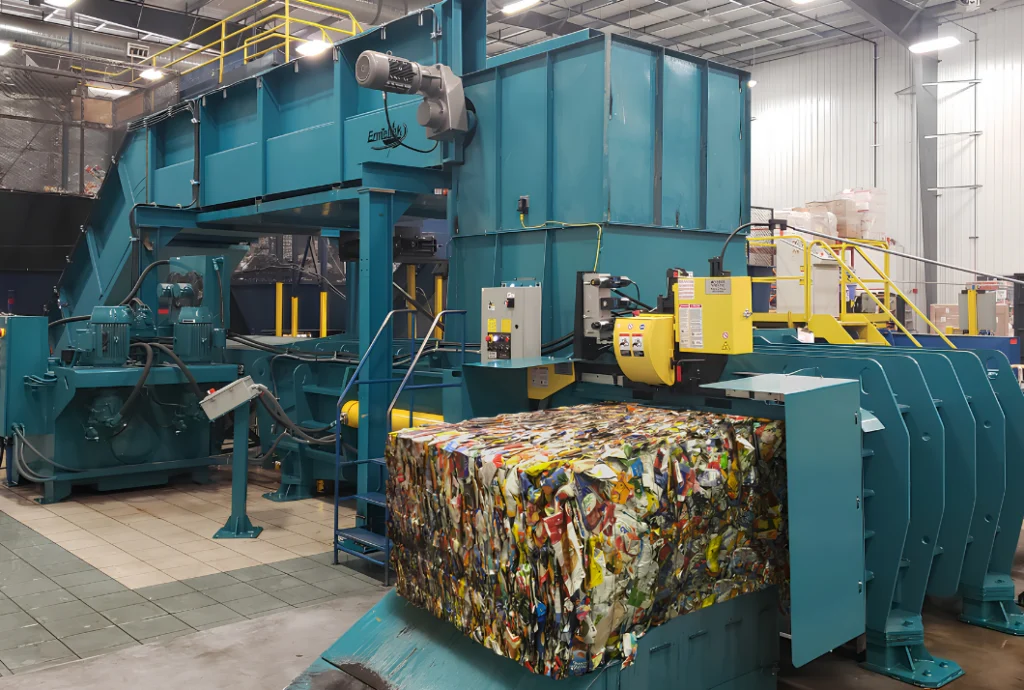
A city recycling program’s processing equipment determines what you can accept, how much you can process, and whether your bales meet the specifications your recyclers require. Getting the baler specification wrong costs money in both directions: underspecification creates throughput bottlenecks, overspecification means paying for capacity you do not use.
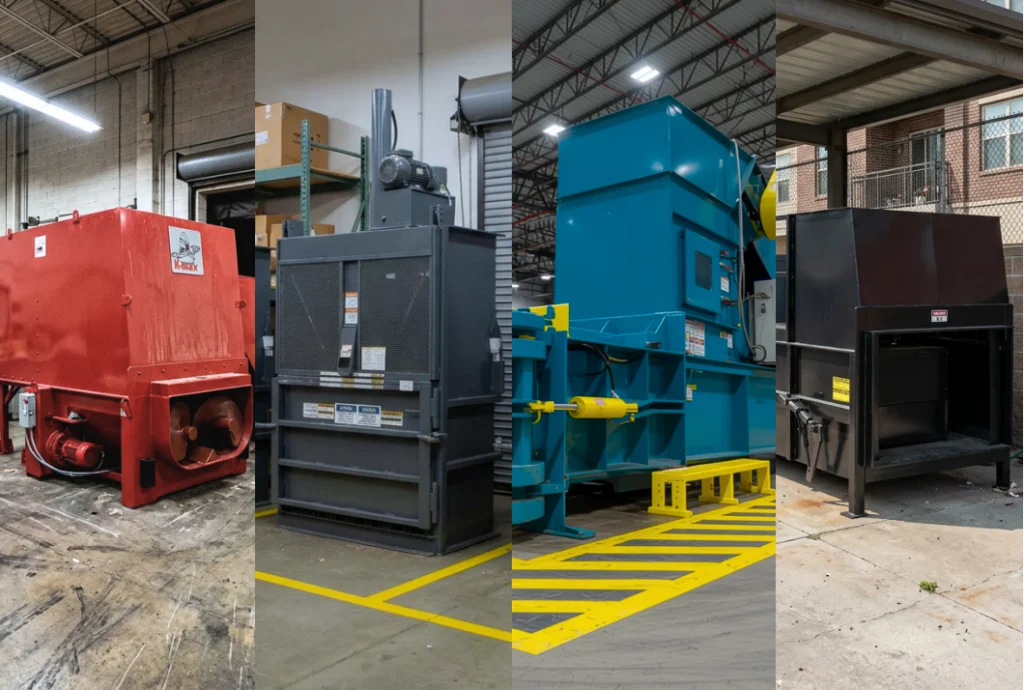
Horizontal balers are the standard equipment choice for municipal recycling centers, but the category includes several distinct configurations. Closed-door manual tie, open-end auto-tie, and two-ram models handle different volumes and material mixes while each type produces different bale characteristics.
Table of Contents
- Key Takeaways
- Why Municipal Recycling Programs Use Horizontal Balers
- Horizontal Baler Configurations for Municipal Recycling
- Closed-Door Manual Tie Horizontal Balers
- Open-End Auto-Tie Horizontal Balers
- Two-Ram Horizontal Balers
- Matching Baler Throughput to Your Program’s Needs
- Daily and Weekly Processing Volume
- Material Mix and Accepted Streams
- Integration with Sorting Lines
- Total Cost of Ownership for Municipal Baler Installations
- Frequently Asked Questions
Key Takeaways
|
Why Municipal Recycling Programs Use Horizontal Balers
Horizontal balers handle continuous material feed from conveyor systems and produce large, dense bales that meet recycler specifications for weight and dimension. They process material faster than vertical balers and with less manual handling, which matters at municipal scale where volumes can reach hundreds of tons per day.
The horizontal compression mechanism handles a wider range of material types than vertical machines, including mixed paper, OCC, film plastics, aluminum, and more. This versatility makes horizontal equipment the right choice when a recycling center processes multiple material streams.
Auto-tie systems on horizontal models eliminate the manual wire-tying step, reducing labor requirements and improving throughput consistency but two-ram horizontal balers are most efficient when regularly changing material streams.
Horizontal Baler Configurations for Municipal Recycling
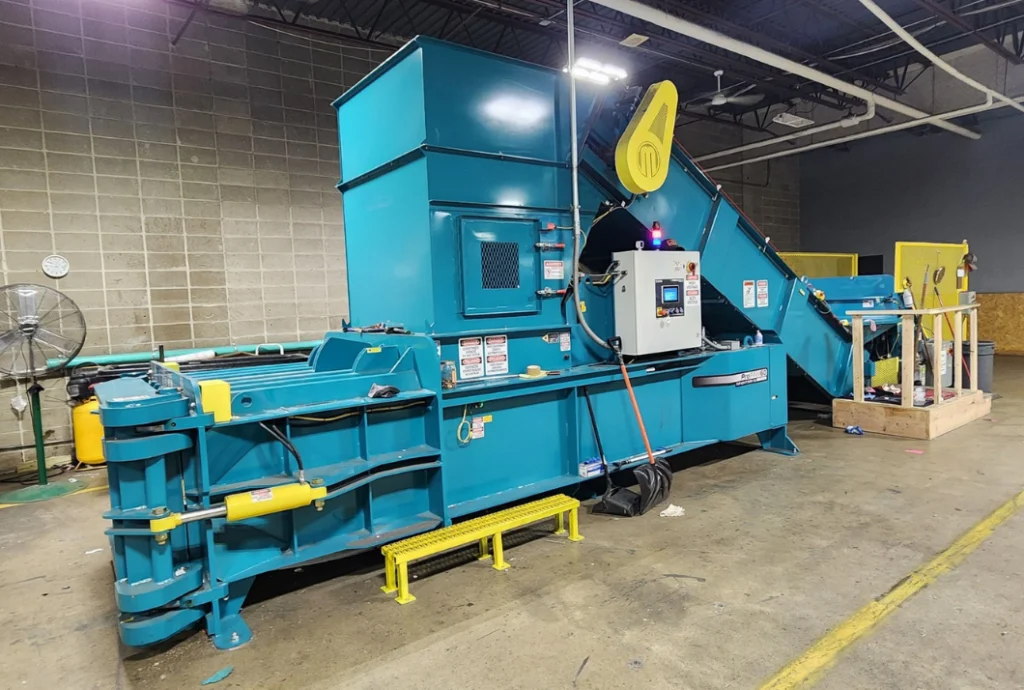
Horizontal balers for municipal recycling come in several configurations, each built around a different balance of throughput, labor, and material flexibility. The right choice depends less on a facility’s size than on how it actually operates, how much material moves through per day, how many streams it accepts, and how consistent that feed is from one shift to the next.
Understanding where each configuration fits along that spectrum is what keeps a program from over-buying capacity it won’t use or under-specifying a machine that becomes a bottleneck.
Closed-Door Manual Tie Horizontal Balers
Closed-door horizontal balers use a closed compression chamber and require manual wire tying to secure finished bales. They are suitable for lower-volume municipal operations with single or mixed material streams where throughput requirements do not justify the cost of an auto-tie or two-ram system.
These models cost less than auto-tie configurations and work well for small to mid-size recycling programs processing up to 15 to 40 tons of material per operating day. They require more labor to operate and tie bales but have simpler mechanical systems and lower maintenance requirements than auto-tie alternatives.
Open-End Auto-Tie Horizontal Balers
Open-end auto-tie horizontal balers feed material continuously and automatically tie bales, making them the most common configuration for consistent single-stream medium to high-volume municipal recycling operations. The open-end design allows continuous material feed without stopping to reset the compression chamber.
Auto-tie systems significantly improve throughput and reduce labor requirements when processing consistent, single-material applications compared to manual-tie models. These machines are well-suited for municipal recycling centers processing 40 to 120 tons per operating day with limited material variety.
Two-Ram Horizontal Balers
Two-ram horizontal balers use two independent hydraulic rams to compress material and produce extremely dense, consistently sized bales. They handle the highest throughput volumes processing up to 60 to 200+ tons of material per operating day, and work with the widest range of material types including materials that are difficult to bale in single-ram machines.
Municipal recycling centers processing high volumes, accepting complex material mixes, or producing bales for premium commodity markets typically specify two-ram equipment. These machines represent a larger capital investment but deliver proportionally higher throughput and bale quality.
| Komar’s municipal equipment specialists work with public works departments to specify horizontal balers matched to their program’s throughput and material mix. If you are planning a recycling center upgrade, contact us to help build your business case. |
Matching Baler Throughput to Your Program’s Needs
The right baler configuration starts with accurate throughput data. Municipal programs should document the following before specifying equipment.
Daily and Weekly Processing Volume
Pull historical collection data to establish how many tons of recyclable material move through the facility per operating day and per week. Account for seasonal variation, as volumes typically peak in certain months and dip in others.
Size equipment to handle your typical peak volume, not your average. A facility that averages 20 tons per day but peaks at 35 tons in high-volume periods needs a machine rated for the peak, not the average.
Material Mix and Accepted Streams
Different material streams have different baling characteristics. OCC and mixed paper are straightforward. Cardboard balers compress cardboard boxes. Film plastics require specific baler capabilities. Commingled recyclables with high contamination require more robust compression to produce acceptable bales.
Talk to your recyclers about bale specifications before finalizing equipment selection. Bale weight, dimension, and wire count requirements vary by commodity buyer, and a baler that does not meet those specifications creates a quality problem downstream.
Integration with Sorting Lines
Municipal recycling facilities often use sorting lines and conveyor systems to separate materials before baling. The baler specification needs to match the output rate of the sorting system. A baler that cannot keep pace with the sorter creates a bottleneck. A baler significantly faster than the sorter generates idle time.
Match the baler’s throughput capacity to the upstream processing equipment rate.
| Komar’s municipal equipment specialists work with public works departments to specify horizontal balers matched to their program’s throughput and material mix. If you are planning a recycling center upgrade, contact us to help build your business case. |
Total Cost of Ownership for Municipal Baler Installations
Equipment purchase price is the most visible cost in a baler decision, but not the most significant over a machine’s operating life.
Service support is a major factor. A baler without local service coverage or a preventive maintenance program will generate more emergency calls and higher cumulative maintenance costs than well-supported equipment. For municipal programs where equipment downtime has public service implications, service reliability is not an optional consideration.
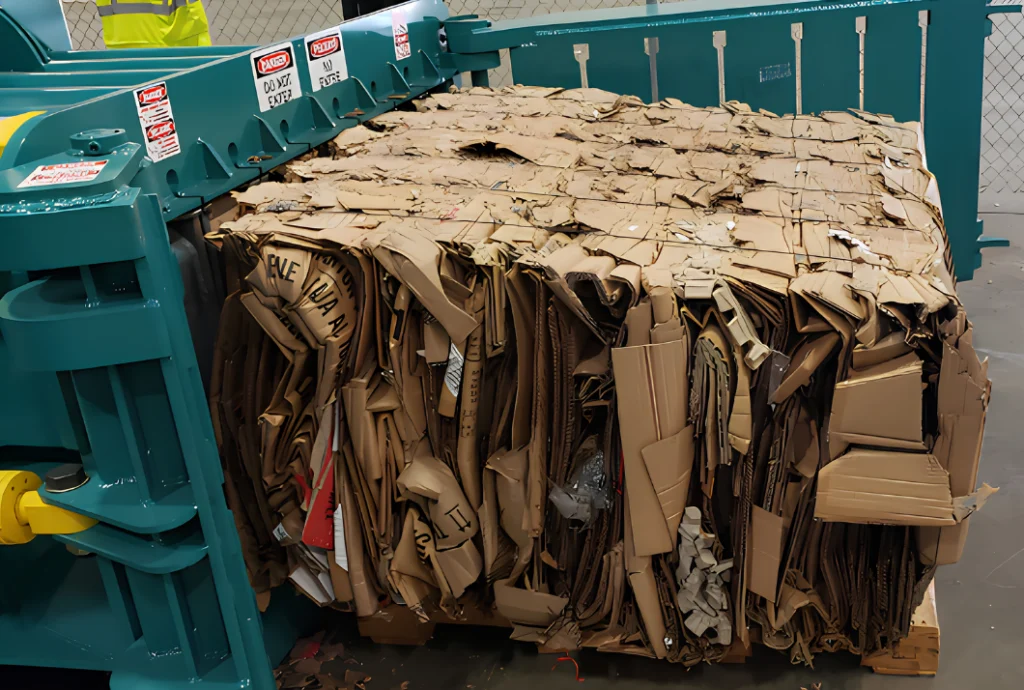
Bale quality also affects long-term economics. A baler producing bales that consistently meet recycler specifications generates more revenue per ton than one producing out-of-spec bales that face price penalties or rejection.
When comparing options, include equipment price, installation, service program costs, expected maintenance spend, and projected bale revenue in the analysis. The lowest-price machine rarely produces the best total cost of ownership.
Frequently Asked Questions
The right choice depends on how many materials that will be processed and throughput volume. Closed-door manual tie models suit lower-volume programs. Open-end auto-tie models handle mid to high volumes efficiently. Two-ram models are specified for the highest-volume operations and demanding material mixes.
Start with historical collection data to establish your typical and peak daily processing volume. Size the machine for your peak volume, not your average. Account for material mix and baler throughput specifications when making the selection.
Closed-door models use a closed compression chamber and require manual bale tying. Open-end models allow continuous feed and include auto-tie systems. Open-end auto-tie models handle higher throughput with less labor, however, are only optimal in consistent, single-material applications.
A well-maintained horizontal baler typically operates for 15 to 25 years in a municipal setting. Service program quality, maintenance consistency, and material type all affect equipment longevity. Preventive maintenance programs maximize equipment life and reduce the likelihood of unplanned failures.
| Komar manufactures a full range of horizontal balers for municipal recycling applications, with service support across North America. Whether you are specifying new equipment for a growing program or replacing aging infrastructure, our specialists can help you identify the right configuration. Contact us to start the conversation. |