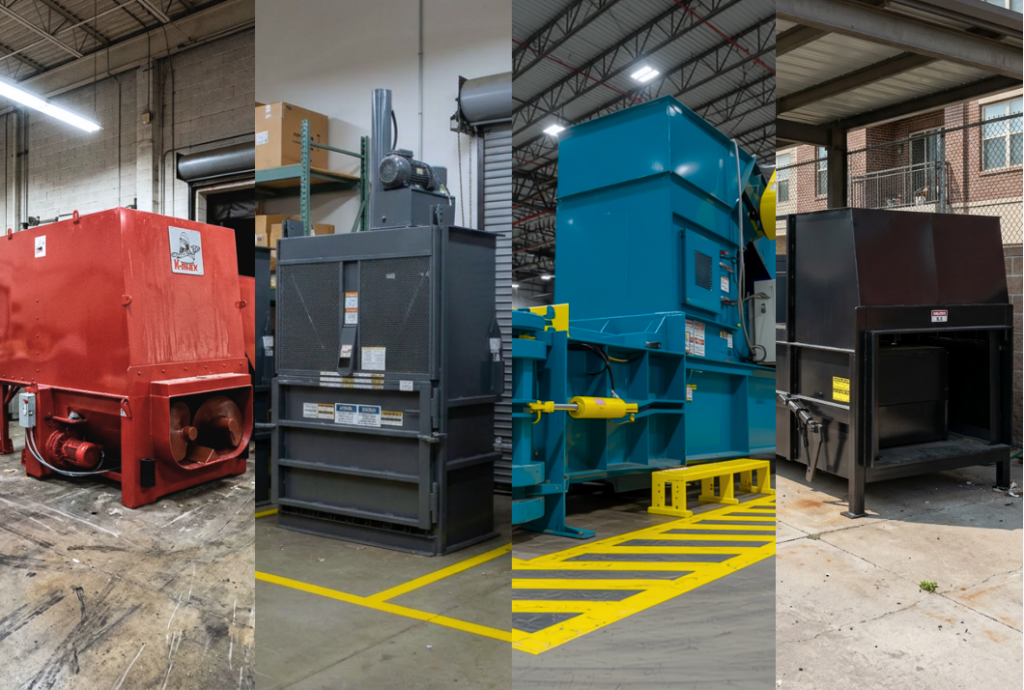
Facility managers and operations leaders face a critical decision: which type of commercial waste equipment best serves your operation’s needs. A waste compactor handles one category of waste, but modern facilities rarely rely on a single piece of equipment. Understanding the full spectrum of options on the market today, from trash compactors, balers, shredders, and auger compactors, helps you make decisions that reduce disposal costs, recover material value, and optimize floor space.
The right equipment selection depends on three factors: your facility’s waste volume, the types of waste material you process, and your available space. A retail store generating 10 tons of cardboard weekly faces a very different decision than a distribution center, or a manufacturer processing mixed plastics and metals.
Table of Contents
- Key Takeaways
- Waste Compactors
- Stationary Compactors
- Self-Contained Compactors
- Vertical Compactors
- Balers
- Vertical Balers
- Horizontal Balers
- Shredders
- Auger Compactors
- Matching Equipment to Your Waste Stream
- Material Type Considerations
- Facility Layout and Space
- The Platform Advantage: Single-Source Equipment
- What Types of Commercial Waste Management Equipment Are Available?
- How Do I Know Which Waste Equipment My Facility Needs?
- What Is the Difference Between a Compactor and A Baler?
- When Should I Consider an Auger Compactor?
- Can I Use Multiple Equipment Types in The Same Facility?
Key Takeaways
|
Waste Compactors
A waste compactor reduces the volume of loose material through compression. Compactors are the foundation of most waste programs because they work on nearly any material such as trash, cardboard, plastic, or mixed refuse.
Stationary Compactors
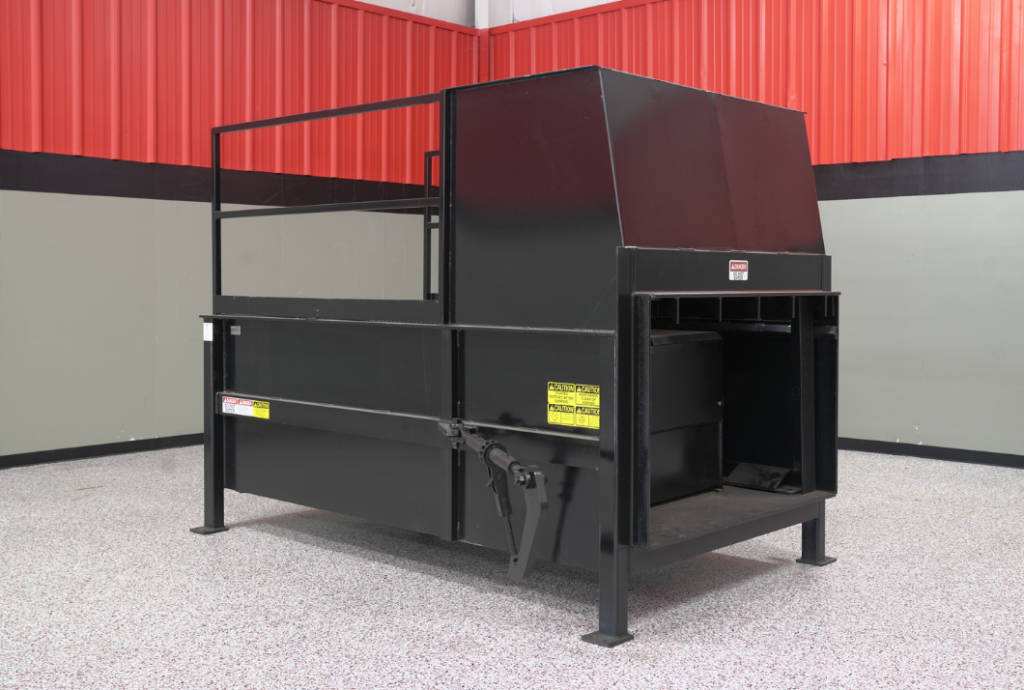
Stationary compactors for dry waste are fixed installations, typically mounted on a concrete pad. They excel in high-volume, consistent-waste environments. A typical stationary compactor reduces volume by 3:1 to 4:1, meaning four cubic yards of loose material becomes one compacted yard. This ratio directly cuts disposal fees. Stationary units require dedicated space, but they integrate into loading docks and waste-handling workflows without disruption.
These are the right fit for retail locations, distribution centers, and manufacturing facilities generating 5 or more tons of waste weekly. Because the equipment stays in place, maintenance and operation become routine. A trained operator can maximize compaction efficiency and maintain consistent density.
Self-Contained Compactors
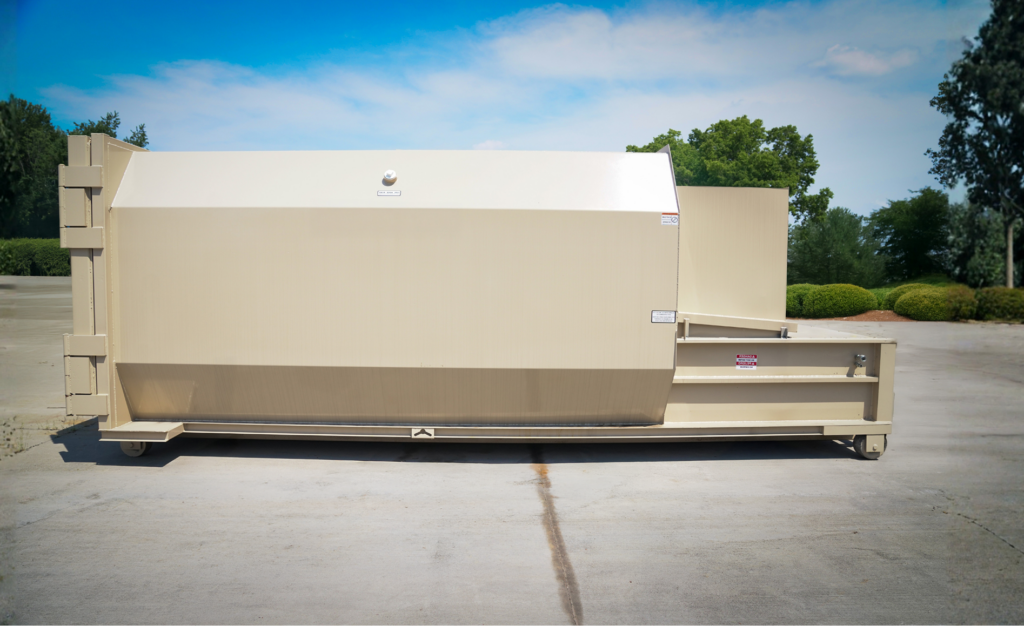
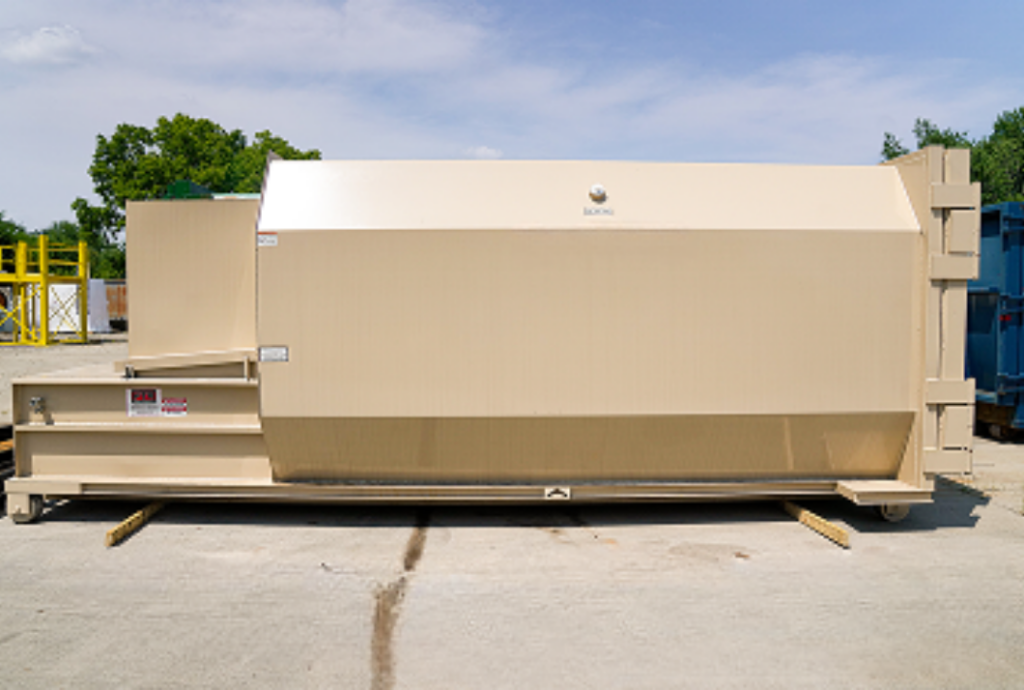
Self-contained units combine the compaction unit and waste container in one sealed, integrated assembly. When the container is full, a hauler removes the entire unit, empties it, and returns it. There is no separate receiver box or detachable container.
The sealed design prevents liquid from escaping, making self-contained units the right choice for wet or semi-wet waste streams. Grocery stores, food service operations, and other facilities generating food waste or high-moisture materials specify self-contained compactors because the sealed container prevents leachate from reaching the dock area and limits pest access and odor.
Self-contained units also work well in locations with limited floor space or constrained loading dock access, since the integrated design reduces the footprint compared to a stationary compactor and separate container.
The cost structure is typically haul-based, meaning charges are incurred each time the unit is removed and emptied. Equipment may be customer-owned or provided as part of the hauling service, depending on the arrangement.
Vertical Compactors
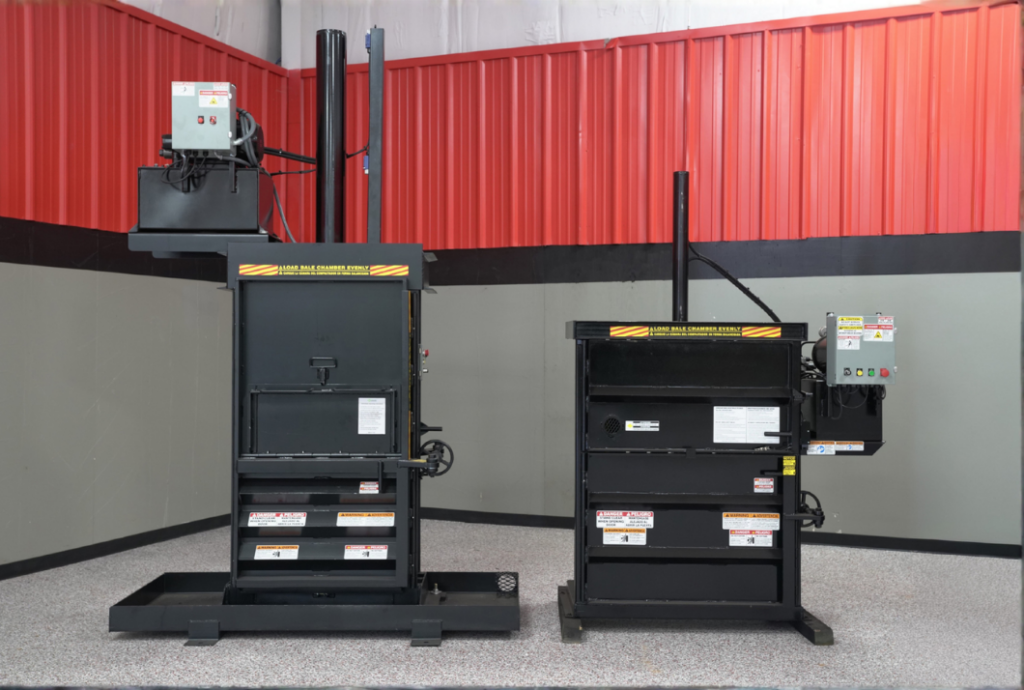
Vertical compactors operate from the top down, using gravity and ram pressure to compress material. They’re designed for small footprint facilities or lots. A vertical compactor occupies a smaller footprint than equivalent stationary models, making them valuable where floor space is constrained.
Vertical units typically reduce volume 3:1 to 5:1, depending on material type and operator practices. They require vertical clearance above the feed opening, but not much floor space. Many vertical compactors handle cardboard, plastic film, and mixed office waste effectively.
| Learn more about Komar’s full equipment lineup and find the right solution for your facility by visiting our equipment pages or speaking with a Komar specialist. |
Balers
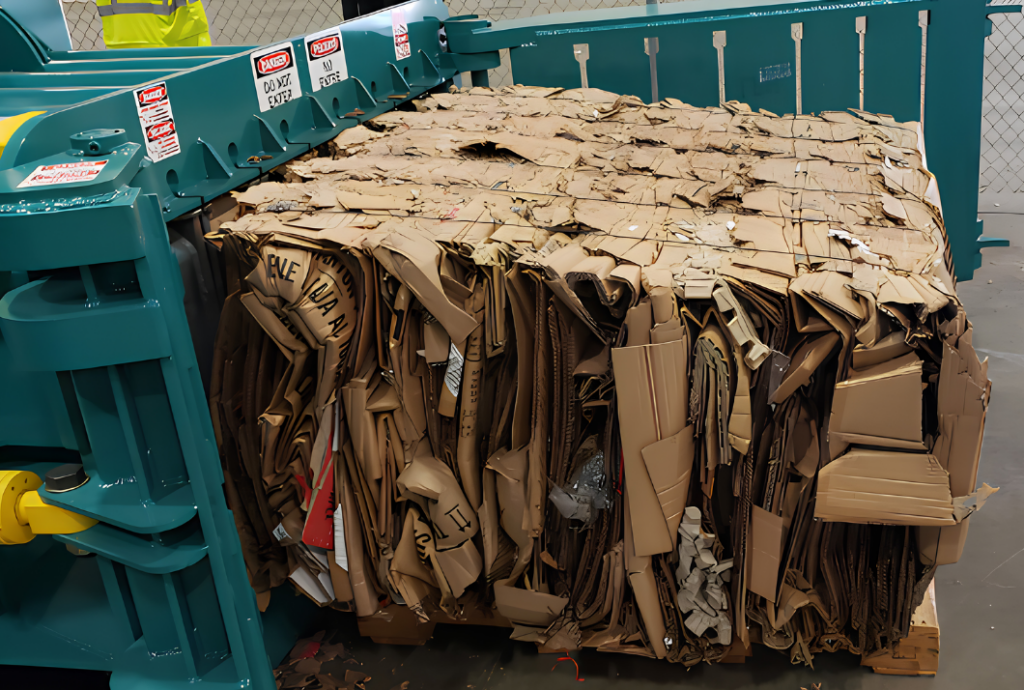
Where a compactor reduces volume, a baler compresses material into a dense, stackable package called a bale. Balers recover material value because bales are saleable commodities. Recyclers, paper mills, and scrap processors actively buy them. A typical bale reduces volume 5:1 to 8:1, and material revenue can contribute to equipment payback over time, though returns fluctuate with commodity markets.
Vertical Balers
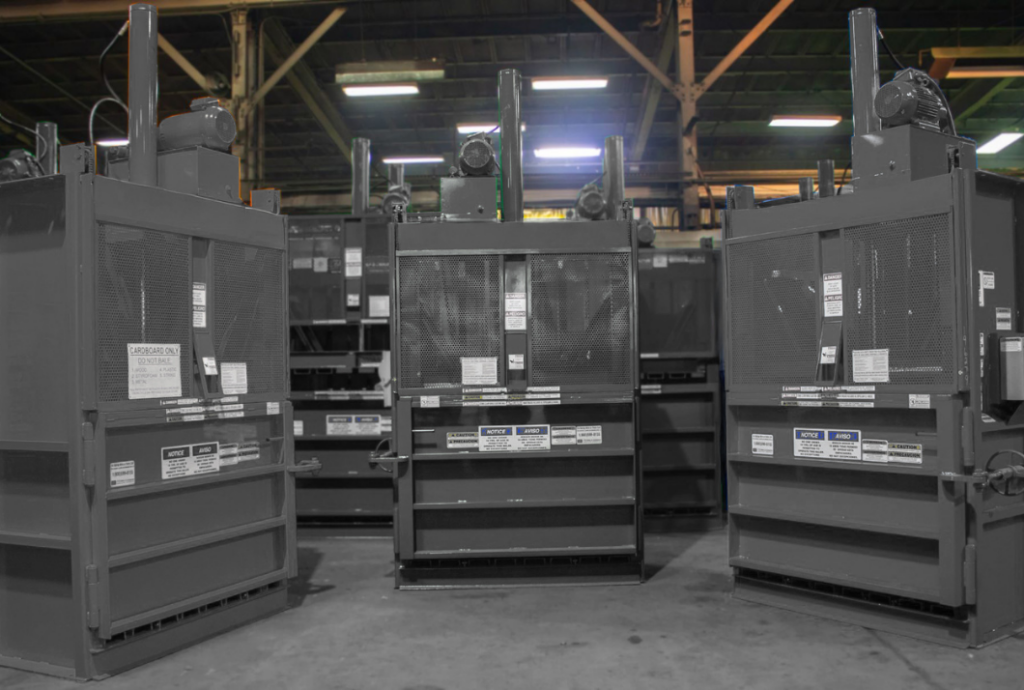
A vertical baler has a vertical compression chamber. Material is fed from the top, compressed downward, and ejected as a bale from the bottom or side. Vertical balers are the most common choice in retail and distribution because they handle high volumes of cardboard efficiently while using minimal floor space.
A mid-size vertical baler processes 5 to 20 tons of cardboard per week. Bale weight varies by material: for OCC, a mill-size bale is at least 1,000 lbs. 1,100 to 1,300 lbs preferred for optimal resale value. Komar’s 60″ balers are all designed to meet the 1,000-lb mill spec (60″L x 30″W x 48″H).
The footprint is typically 4 feet by 6 feet, making them suitable for back-room areas. Labor requirements are generally low. One operator can manage multiple balers depending on how often bales are being generated.
Horizontal Balers
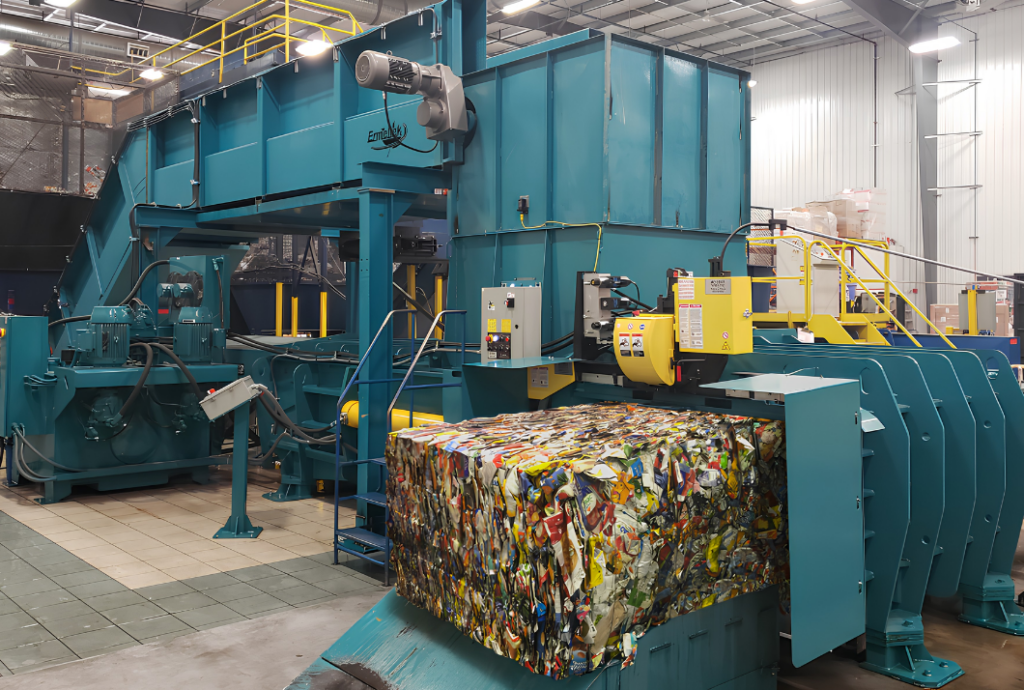
A horizontal baler uses a ram that compresses material into a horizontal chamber. Bales are produced at high density and weight, often 1,000 to 2,500 pounds per bale. Horizontal balers process larger waste volumes than vertical units, making them standard in high-volume manufacturing, recycling facilities, and large distribution centers.
The trade-off: horizontal balers require more floor space and ceiling height. Mid-sized horizontal balers process 20 to 100 or more tons per week depending on the model. Large horizontal balers can process much more. For facilities exceeding a vertical baler’s capacity or necessary resource requirement, a horizontal unit becomes cost-effective. The heavier bales reduce transportation costs per ton of material.
| Need help matching equipment to your facility? Contact a Komar equipment specialist to assess your waste stream and find the right combination of equipment for your operation. |
Shredders
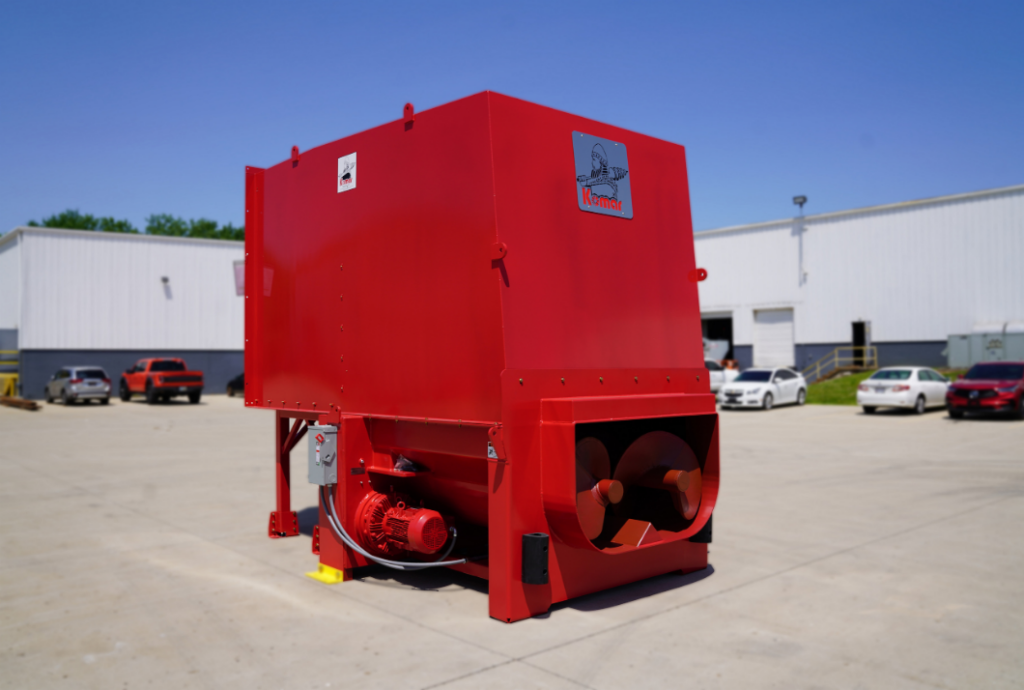
An industrial shredder tears or cuts material into smaller pieces, reducing volume and preparing material for downstream processing. Shredders handle materials balers and compactors cannot. Volume reduction varies: plastics shred 20:1, while metals shred 3:1 to 5:1.
Shredders are common in manufacturing environments where mixed waste streams are the norm. A plastics injection-molding facility generates plastic scrap, cardboard, and non-ferrous metal scrap. A shredder processes these materials, preparing the material for sale or proper disposal. Shredders also function as pre-processors for balers: a facility might shred plastic, then bale the shredded material for sale to recyclers.
Auger Compactors
An auger compactor uses a rotating screw mechanism to process and reduce material. Augers are application-specific. The right configuration depends on your primary waste stream.
Komar’s primary auger application is wood waste and corrugated (OCC) processing. Electric auger compactors can be positioned at dock doors, without the indoor footprint and ceiling requirements of a horizontal baler. This makes them practical for large distribution and manufacturing operations processing wood scrap, pallets, and high volumes of corrugated cardboard.
A dewatering auger compactor handles wet or moisture-saturated material including saturated cardboard and similar streams. The auger extracts moisture while compressing the load, reducing both disposal volume and hauling weight. These configurations are common for processing inorganic materials like paper/pulp mills and municipal collection centers.
Volume reduction ranges from 5:1 to 8:1 depending on the application and material type. Selecting the right auger configuration requires matching the machine type to your specific waste stream.
Matching Equipment to Your Waste Stream
The right equipment combination depends on three things: what you are generating, how much of it you produce, and what you want to do with it.
If you have enough recyclable material like cardboard, plastics, or other commodities, to generate rebates, the equipment equation typically involves a baler paired with a compactor, with the compactor type determined by your waste stream. Dry waste pairs with a stationary compactor. Wet waste requires a self-contained unit. Some operations run two compactors, dedicating one to OCC and one to general waste to keep streams separate and maximize recovery value.
If recyclable volumes are too low to justify separation, consolidating everything into one compactor to optimize container weight for landfill disposal is often the more practical choice.
There is no single volume threshold that triggers one configuration over another. The right answer requires understanding your waste mix, your volume, and your operational goals. A Komar application specialist can work through that analysis with you before any equipment is specified.
Material Type Considerations
Cardboard and paper are the easiest materials to manage with a vertical or horizontal baler. Both compress these materials to high density, and recyclers actively purchase the bales. Material recovery contributes to equipment payback, though returns fluctuate with commodity markets. Cardboard typically yields $50–$150 per ton, and that range shifts year over year. For a six-figure horizontal baler, payback timelines extend accordingly.
Plastic film, bags, and wrap present specific challenges that affect both equipment selection and downstream handling. The primary issue is bulk density. Film plastic is extremely light relative to its volume, so producing a bale of acceptable weight requires significantly more material than OCC or rigid plastics. For lower-volume operations, this makes baling film uneconomical.
The second issue is elasticity. Film plastic has memory and tends to expand after baling and tying off, which makes bales difficult to stack and creates storage and transport problems.
Material handling and feed consistency are also factors, though these are operational issues rather than equipment limitations.
Pre-shredding rigid plastics before baling can improve density, but it can add significant cost and maintenance complexity and represents a workflow decision. It also assumes your downstream recycler accepts shredded or flake-form bales, which is not universal. Confirm market acceptance before investing in shredding capability.
For facilities where film volume is insufficient to justify baling, a stationary compactor mixed with other dry waste materials is often the more practical solution.
Plastic film does carry resale value, though less than OCC and subject to market fluctuation. Whether that value justifies the equipment and handling investment depends on the volume your operation generates.
Ferrous metal scrap and foam are best handled with a shredder. Wood waste is best addressed with an auger compactor. These materials take up disproportionate space in landfills or incinerators, and an auger or shredder dramatically reduces disposal volume. Shredded metal scrap also sells more readily than loose pieces to scrap processors.
Facility Layout and Space
Vertical and horizontal balers are most commonly installed indoors. When installed outdoors, they typically require weather protection or an enclosure, along with appropriate environmental controls based on climate and operating conditions, to support reliable performance, protect components, and ensure safe operation.
Stationary ram and auger compactors require a separate removable container. These units are commonly installed outside the facility, often at a dock door, and connected to the building through an enclosure that allows employees to load material from inside. This setup requires adequate exterior space for container access and service.
Self-contained ram and auger compactors are installed and accessed in a similar manner, but the compaction unit and container are integrated into a single piece of equipment, eliminating the need for a separate detachable container.
For indoor installations, vertical balers and compactors are commonly used in loading dock or back-of-house areas where space is limited. Horizontal balers typically require a larger dedicated footprint and are better suited for facilities with sufficient floor space to accommodate material infeed, bale discharge, and service access.
Ceiling height is a key consideration for all equipment types. Vertical equipment generally requires additional overhead clearance, while horizontal balers often have higher overall height and structural requirements. Older buildings with low or drop ceilings can limit equipment options and should be evaluated early in the planning process.
Adequate access for maintenance and service is essential. Equipment should be positioned to allow technicians to safely access required service areas. Tight corners, restricted aisles, or constrained placements can complicate maintenance and negatively impact uptime.
| Need help matching equipment to your facility? Contact a Komar equipment specialist to assess your waste stream and find the right combination of equipment for your operation. |
The Platform Advantage: Single-Source Equipment
Many facilities use equipment from different manufacturers. A compactor from one vendor, a baler from another, specialty waste management equipment from a third. This fragmentation creates service headaches: multiple service contacts, inconsistent spare-parts availability, and longer downtime during repairs.
A unified platform from one manufacturer simplifies procurement and operation. You work with one service network, standardize spare parts, and get equipment designed to work together. A facility with a Komar compactor and baler benefits from coordinated service, compatible spare parts, and an integrated support team that understands your full waste program.
Ready to optimize your facility’s waste equipment? Contact a Komar equipment specialist to assess your waste stream and find the right combination of equipment for your operation.
Frequently Asked Questions
The main categories are compactors (stationary, self-contained, vertical), balers (vertical and horizontal), shredders, and auger compactors. Each type is designed for different applications based on material characteristics, waste volume, and handling or disposal objectives.
Assess three factors: your weekly waste volume in tons, the types of materials you generate (cardboard, plastic, metal, wet waste, etc.), and your available space. A facility generating 10 tons of cardboard weekly is well-served by a vertical baler.
A compactor reduces volume through compression, creating a denser load for disposal. A baler compresses recyclable material into a discrete, stackable package that can be sold. Balers recover material value; compactors help reduce disposal costs. Balers are ideal for high-value materials like cardboard. Compactors work for general waste and materials without a ready resale market.
Komar auger compactors serve two primary applications: high-volume wood waste and OCC processing, and dewatering of wet or moisture-saturated material. If your operation generates significant wood scrap or processes high volumes of corrugated, an electric auger offers throughput and footprint advantages. For wet waste streams including saturated cardboard or wet organic material, a dewatering or organic separation auger extracts moisture while reducing volume.
Yes, and for most high-volume or mixed-stream facilities, that’s the right answer. A baler and compactor combination covers the needs of most retail and mid-volume commercial operations. Adding a shredder or auger requires substantial throughput — these machines represent significant capital investment and are most common in large distribution centers and high-volume manufacturing facilities. When multiple equipment types are needed, sourcing from a single manufacturer simplifies service, spare parts, and support.
| Learn more about Komar’s full equipment lineup and find the right solution for your facility by visiting our equipment pages or speaking with a Komar specialist. |