
Think about everything that happens on a large college campus. There are dining halls feeding thousands of students, residence halls operating much like apartment buildings, warehouses receiving pallets of supplies, and stadiums that fill up on game day. Some campuses also have hospitals, research facilities, retail operations, and maintenance shops.
A university is a small city, and somewhere in that city there’s probably an operation that looks a lot like yours.
A dining hall handles food waste and packaging, while a warehouse may generate large amounts of cardboard and plastic film. Residence halls have to move trash from multiple floors to a central collection point, and stadiums have to manage enormous changes in waste volume depending on the event schedule. Each presents a different challenge, even though they’re all part of the same campus.
For anyone responsible for waste management, it’s an interesting comparison. A college campus brings together many of the same waste streams and operational challenges found across commercial and industrial facilities. The decisions around equipment, collection schedules, available space, and maintenance are often the same, whether you’re managing a dining hall, grocery store, distribution center, residence hall, apartment building, or manufacturing plant.
The Dining Hall: Start With What’s Going Into the Compactor
Walk behind a large dining hall and you’ll find a very different waste stream than you’d find behind most warehouses.
There’s food waste, liquids, packaging, and cardboard. Volume changes throughout the day and can change again when students leave for breaks or summer.
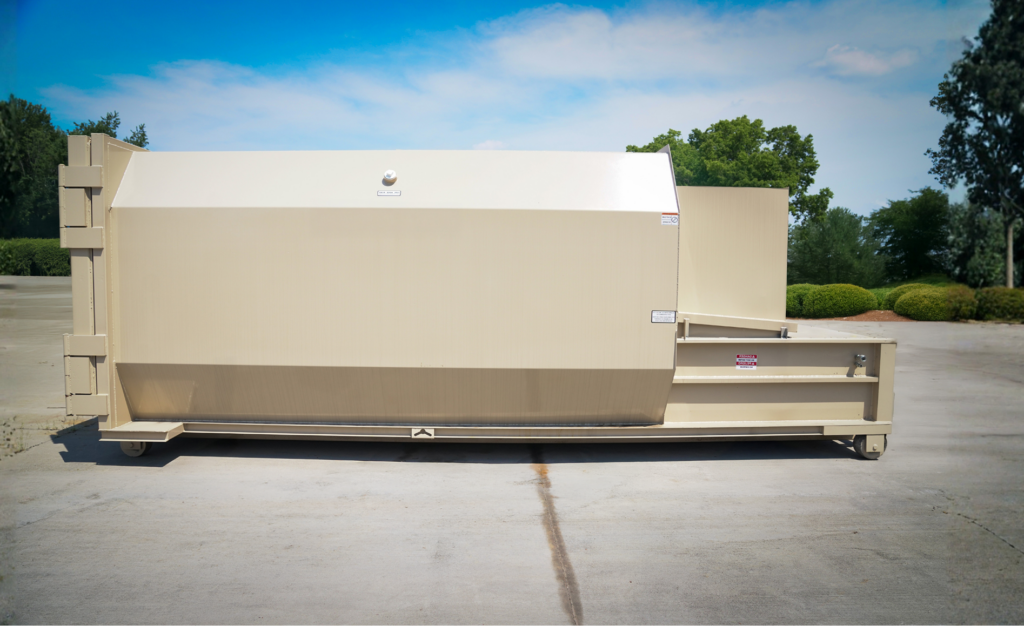
Whatever equipment is there has to fit the waste stream. For wet waste and food applications, that often means a self-contained compactor designed to contain waste and liquids in one sealed unit.
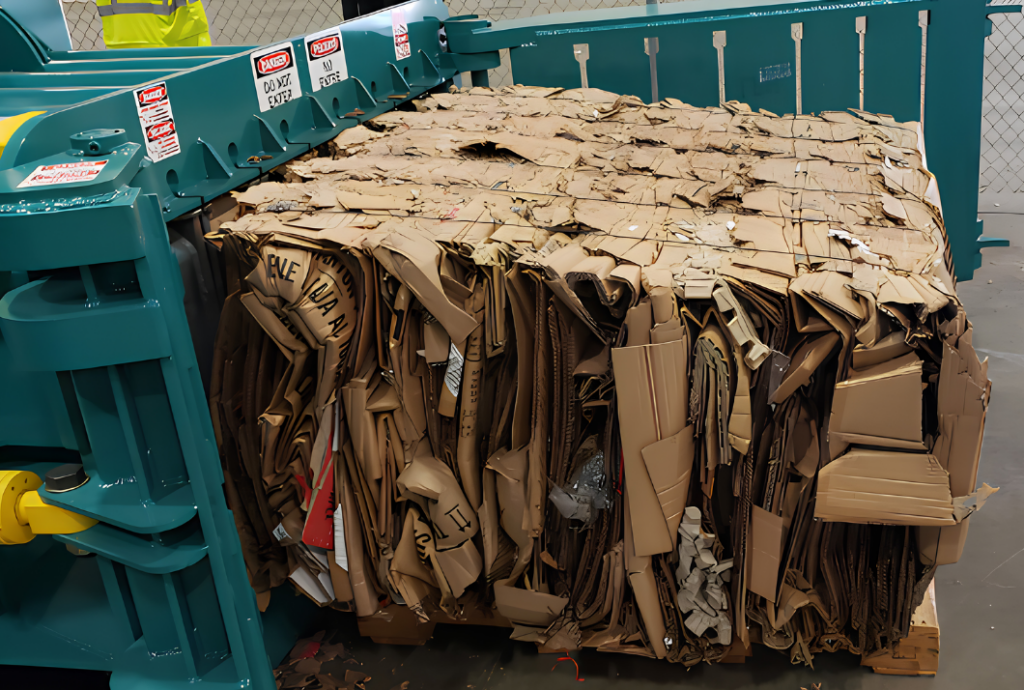
Cardboard is a separate question. If it can be kept clean and dry, it may be better suited to a baler, depending on volume and available space, and baled cardboard typically earns higher rebates than loose cardboard. In a food setting, that also means keeping cardboard away from wet waste, since contaminated cardboard has to be separated from clean material. On some campuses, recyclables from several buildings are collected and brought to a central location for processing.
A restaurant, grocery store, hotel or food processing operation faces the same questions.
- What are you throwing away?
- How much?
- What’s wet and what’s dry?
- What’s recyclable?
- How much room do you have?
- How often is everything being hauled?
The Residence Hall: The Building Is Part of the Waste System
Hundreds of people are generating trash throughout a multi-story building. Getting that material from the upper floors to a collection point is part of the problem.
Chute-fed systems handle that step. Waste moves from the floors above to equipment below rather than being carried through the building one bag at a time.
Komar offers stationary compactors designed specifically for apartment and chute-fed applications, along with chute-feed configurations for other compactor systems.
The same issue shows up in apartments, hotels and other multistory buildings.
- Where does the waste start?
- How does it get to the equipment?
- Where will the equipment sit?
- Can a hauler get to the container?
- Can technicians get to the machine when it needs service?
Sometimes the best equipment decision starts with the building.
The Warehouse: Cardboard Changes the Equation
Across campus, central receiving has a different problem.
Pallets arrive. Boxes get opened. Packaging piles up.
If you’re handling a lot of cardboard, throwing loose boxes into a container may mean you’re using valuable space to store and transport air.
Depending on the volume and what you want to do with the material, there are several ways to handle it.
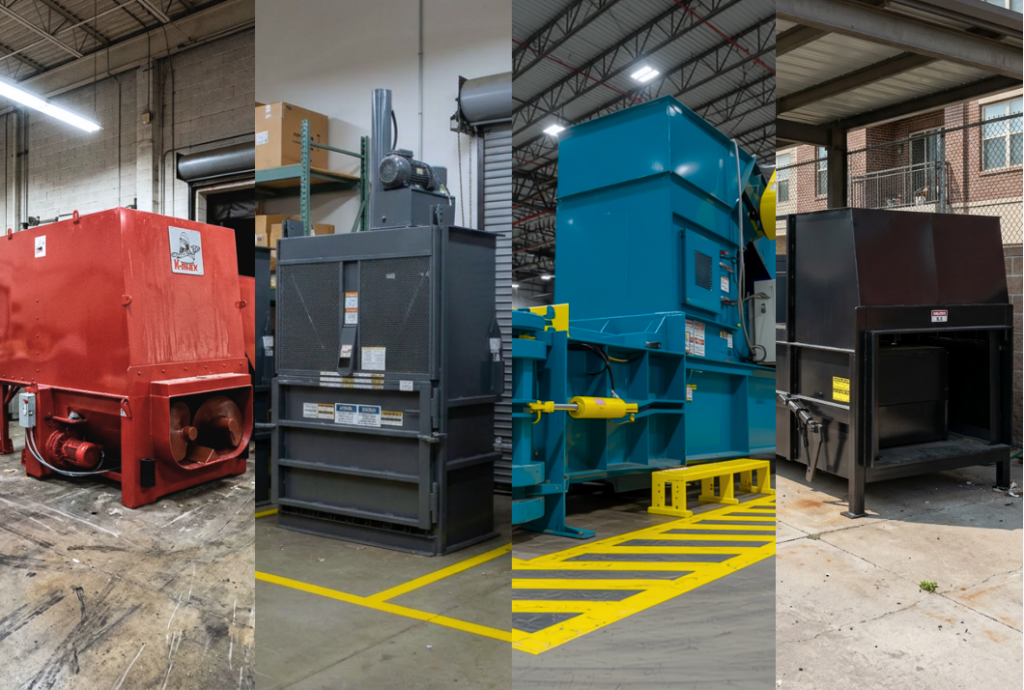
A vertical baler can make sense for moderate volumes of recyclable cardboard. Higher-volume operations may move to a horizontal baler. Where large amounts of cardboard and packaging need to be continuously processed and compacted, an auger may be another option.
Komar uses all three across distribution and logistics applications.
Not every pile of cardboard needs a baler or an auger. Start with how much material you’re generating and what you’re doing with it now.
- How much space is it taking up?
- How much labor goes into handling it?
- How often is it being hauled?
- Does the material have recycling value?
A warehouse on a college campus and a million-square-foot distribution center operate at very different scales. The questions aren’t all that different.
The Stadium: Tuesday Isn’t the Day to Design Around
Most days, a football stadium is pretty quiet.
Game day isn’t.
Tens of thousands of people can arrive and leave within a matter of hours, with all the cups, bottles, food containers, cardboard and trash that come with them.
Plenty of facilities have their own version of game day.
Retailers have the holidays. Distribution centers have peak shipping periods. Hotels have events and tourist seasons. Manufacturers have production ramps. Multifamily properties have move-in and move-out periods.
If you size the waste operation around an average Tuesday, what happens on your busiest Saturday?
That may affect equipment capacity. It may affect pull frequency. It may require temporary changes during peak periods.
The important thing is knowing the peak is coming before the containers are full.
The Hospital: What Happens When the Equipment Stops?
A hospital keeps generating waste whether its compactor is running or not.
So does a grocery store. A manufacturing plant. A distribution center. A busy apartment building.
If a critical piece of waste equipment goes down, the questions get practical very quickly.
- Who do you call?
- How quickly can someone respond?
- Can that company work on the brand of equipment you have?
- Can they get the parts needed to get it running again?
- And what does the operation do with its waste until the machine is back online?
Komar provides service across North America, and supports most major waste and recycling equipment brands, so facilities with mixed fleets aren’t limited to service on Komar platform equipment. Preventive maintenance programs can also help identify wear and other problems before they turn into an unplanned shutdown.
When the equipment is important to the operation, the service plan matters as much as the machine.
| Want a second set of eyes on your equipment and service plan? Schedule a free waste stream evaluation with Komar |
The Facilities Department: Know What You Have
Now zoom back out and look at the whole campus.
The University of Minnesota Twin Cities runs its own waste collection operation, with its own drivers and university-owned trucks serving 259 campus buildings. In a 2020 procurement document, the University of Florida set a goal of 15 years of useful life for its compactors and said it buys one to three new compactors in an average year to replace aging units.
Managing equipment at that scale requires knowing what’s out there.
- What equipment do you have?
- Where is it?
- Who owns it?
- How old is it?
- What are you spending to maintain it?
- Which machines are starting to cost more to keep running?
- Which one would cause the biggest problem if it failed tomorrow?
You don’t need 259 buildings for those questions to matter.
The University of Southern Maine took on the own-versus-rent question in a 2022 waste-hauling RFP. The university owns its compactors but asked bidders for rental pricing in case they broke down or became too expensive to maintain.
That’s the kind of decision worth thinking through while the equipment is still running.
Every Facility Has Its Own Campus
That’s what makes a university such a useful way to think about waste.
There isn’t one campus waste stream.
There’s food waste at the dining hall. Cardboard at receiving. Trash moving through chutes in the residence halls. Huge volume swings at the stadium. Equipment that can’t stay down for long at the hospital.
Look around your own operation and you may find the same thing.
One area is generating cardboard. Another has wet waste. One location is constantly calling for pulls. Another has equipment that has been there so long nobody is quite sure how old it is. Somewhere else, the waste stream has changed but the equipment hasn’t.
Those aren’t necessarily one waste problem. There may be five different ones.
So before the conversation turns to a new compactor, baler, auger, or other processing equipment, take a look at what is happening now. Think of it as a simple waste audit.
- What are you throwing away?
- How much?
- Where is it coming from?
- How is it getting to the equipment?
- How much labor goes into handling it?
- How often is it being hauled?
- What happens during your busiest week?
- What happens if the equipment goes down?
Those answers tell you a lot about what should come next.
Campus Waste Management FAQ
How long does a commercial trash compactor last?
It depends on how the compactor is used and maintained. In a 2020 procurement document, the University of Florida set a goal of 15 years of useful life for its compactors, noted that some last even longer with proper preventive maintenance, and said it buys one to three new compactors in an average year to replace aging units.
Should a facility rent or buy a trash compactor?
It depends on how long you plan to use the site, what the current equipment costs to keep running, if you’re positioned to spend capex or if lease/rental is better for the books, and how much control you want over service and replacement timing. The University of Southern Maine weighed both in a 2022 waste-hauling RFP. It owns its compactors but asked bidders for rental pricing in case they broke down or became too expensive to maintain.
What is the difference between a self-contained and a stationary compactor?
A stationary compactor connects to a detachable container and is designed for dry waste such as cardboard and plastics. A self-contained compactor houses the compaction mechanism and the container in one sealed unit, which suits wet or food waste that produces liquids. The sealed design helps control leaks, odor, and pests.
When does a cardboard baler make more sense than a compactor?
When cardboard and other recyclables can be kept separate. A baler compresses that material into dense bales that reduce hauling and can command higher value, while a compactor reduces the volume of waste headed for disposal. Komar notes that facilities often consider moving from a vertical to a horizontal baler at around 12 to 15 tons of material per week.
How do universities manage waste?
Many use a mix of approaches. The University of Minnesota Twin Cities runs its own collection with its own drivers and university-owned trucks. Other campuses own their compactors and hire a hauler to empty them, or have the hauler supply the equipment. On a single campus, dining halls, residence halls, warehouses, stadiums, and hospitals each create a different waste stream.
Take a Walk Around Your Own “Campus”
Komar works with facilities to evaluate their waste streams, volume, available space and operating requirements before recommending equipment.
That could lead to a stationary, self-contained or vertical compactor. It could mean a vertical or horizontal baler. For higher-volume applications, it could mean an auger or another engineered system.
Or it could mean the equipment you already have is the right equipment and there are other ways to improve how it’s being used or serviced.
Either way, the first of the waste management best practices is the same everywhere. Start with the operation.