Komar Strengthens Its North American Platform With the Acquisition of Metro Compactor Service
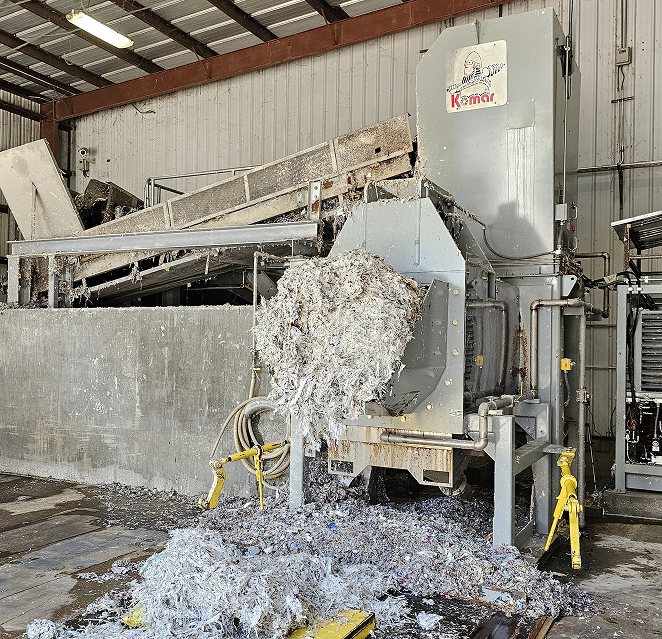
Learn More →Meeting continually increasing waste stream diversion requirements requires innovative solutions. Komar’s Organic Separation Systems efficiently separate organic material from mixed waste streams and also recover liquids through depackaging. These processes create clean organic slurry ready for composting or digestion.
Engineered through decades of waste-processing expertise, Komar’s Organic Separation Press solutions deliver precise, high-efficiency extraction of liquids and organics—setting the standard for sustainable waste stream management.
Designed for lighter-duty depackaging and organic separation—ideal for clean up of source-separated organic processing residuals.
Intermediate version built to handle moderate waste volumes with enhanced dewatering and separation functionality.
A mid-capacity mixed-waste processor which macerates waste and liberates organics in moderate to mid-volume operations.
Largest in the series, built for high-volume processing for municipal solid waste, pulp rejects, and the most-demanding mixed-waste separation applications.
Packaging and liquids go one direction, solid waste is sent another way. The result? Clean organic material that’s ready for composting, digestion, or disposal.
Engineered for heavy industrial and municipal applications with continuous-duty performance.
System design integrates seamlessly with your operations.
Removal of organics can significantly reduce the volume and weight of waste directed to landfills.
Achieves high separation purity for organics through a 0.090″ wedge bar dewatering gap.
Heavy-duty carbon steel construction.
| Organic Separation Systems | ![]() OSP-20 | ![]() OSP-60 | ![]() OSP-100 | ![]() OSP-250 |
|---|---|---|---|---|
| Horsepower | 20 | 60 | 100 | 250 |
| Drive Type | Electro-Mechanical | Electro-Mechanical | Hydrostatic | Hydrostatic |
| Power Requirement | 480 V, 3 PH, 60 Hz | 480 V, 3 PH, 60 Hz | 480 V, 3 PH, 60 Hz | 480 V, 3 PH, 60 Hz |
| Auger Speed | 18.6 RPM | 15.1 RPM | Up to 16.2 RPM | Up to 24 RPM |
| Auger Torque | 5,650 ft-lbs | 20,900 ft-lbs | 32,400 ft-lbs | 61,150 ft-lbs |
| Auger Flight Diameter | 20″ | 31-3/4″ | 30″ | 34-3/4″ |
| Auger Shaft Diameter | 6″ | 8″ | 8″ | 12″ |
| Organic Recovery Rate – Mixed Waste | 20–45% | 20–45% | 20–45% | 20–45% |
| Organic Recovery Rate – Depackaging | Complete Free Liquid Removal | Complete Free Liquid Removal | Complete Free Liquid Removal | Complete Free Liquid Removal |
| Throughput | 1–3 tons / hr | 3–6 tons / hr | 6–15 tons / hr Up to 20 tons / hr in Saturated Pulp Waste | 20–50 tons / hr |
| Chamber Opening (L × W) | 32″ × 31″ | 54″ × 63″ | 48″ × 72″ | 60″ × 76″ |
| Weight (Base Unit) | 4,300 lbs | 11,900 lbs | 12,900 lbs | 24,400 lbs |
| Feed Materials | Depackaging Containers Hammermill Residuals | Bagged and Loose Mixed Solids Wet Commercial and Industrial Waste Depackaging Containers Pre-sorted RDF Residual | Bagged and Loose Mixed Solids Wet Commercial and Industrial Waste Depackaging Containers Pre-sorted RDF Residual | Bagged and Loose Mixed Solids Wet Commercial and Industrial Waste Depackaging Containers Pre-sorted RDF Residual |

“Our disposal costs have dropped, which at least covers the cost of the compactors. Aside from the monetary aspect, the compactors allow the stores to be considerably cleaner. Cleanup at night is much easier because we have no trash cluttering up the back room of the store. All in all, we are very pleased with the compactors.”
Doug Gehrig, CEO, McDonald’s of Southwest Louisiana
“Our facility is a 110,000-square-foot operations center for Goodwill of Southwestern Pennsylvania. We get between 1.2 to 1.5 million pounds of material a day, and tonnage increases significantly during the summer. The Komar auger has increased daily soft trash, wood pallets, and general trash efficiency by 30% and 40% with furniture. I love to give shock-and-awe tours to show off the Komar Auger, which compacts 8.5 to 9 tons into each payload.”
Bob Kagle, Director of Retail Logistics, Goodwill of Southwestern Pennsylvania
“We estimate that the Komar Auger has saved us 1,300 hours of labor per year, has reduced our hauling cost by two-thirds, and has given La-Z-Boy a safer process and more floor space.”
Troy Kvingedal, Facilities Supervisor, La-Z-Boy
Komar Industries provides engineered organic separation press (OSP) systems designed to help facilities meet increasing landfill diversion requirements and extract value from organics recovered from municipal solid waste (MSW) streams. As regulations and sustainability expectations rise, operations need reliable technology that separates organics from municipal and industrial waste with consistency and efficiency.
Our solutions are tailored to meet the unique needs of a wide range of industries:
Organic separation presses extract organic matter from mixed streams of packaging, liquids, contaminants, and other wastes. Materials that can be composted or digested are diverted to the appropriate channel while everything else is redirected for disposal.
Yes. Organic separation presses are designed to process rigid, flexible, and multilayered packaging materials.
The organic output is a slurry—ideal for composting or anaerobic digestion.
The dry discharge has over 75% of organics removed and can be considered for downstream recycling extraction or waste-to-energy potential.
Yes. Komar offers in-feed hoppers, conveyors, and automated discharge options for seamless integration into existing production lines.
Our systems are engineered for long life and include design features to assist with monitoring performance and ease of repairs to keep your downtime to a minimum.
Removal of organics provides a significant weight reduction from solid waste, which lowers tipping fees and can also reduce trips to the landfill.
Yes. Organic separation is key to meeting expanding landfill diversion and ESG targets.
We are a waste solutions company. With a wide array of application-specific models and advanced engineering capabilities, we look forward to guiding you to the best solution for the job.
Schedule a free waste stream evaluation to identify the right equipment and processes for your space, waste types, and volume.
Komar Industries provides engineered organic separation press (OSP) systems designed to help facilities meet increasing landfill diversion requirements and extract value from organics recovered from municipal solid waste (MSW) streams. As regulations and sustainability expectations rise, operations need reliable technology that separates food waste and organics from municipal and industrial waste with consistency and efficiency.
What Is an Organic Separation Press
An organic separation press uses a compression auger and a dewatering system to separate liquid organics from mixed solid waste streams including packaging, paper, and other inert materials. The system produces two outputs. The first is a nutrient-rich liquid stream suitable for composting or anaerobic digestion. The second is a dry residual that can be sorted for beneficial reuse or sent to landfill when necessary.
Komar offers a range of models for liquid-removal applications, available as stand-alone units or as part of integrated systems. Primary models include the OSP-20, OSP-60, OSP-100, and OSP-250. The OSP-20 is designed for depackaging materials such as plastics, aluminum, and multi-layer containers. The OSP-250 is engineered for high-volume applications and can process approximately 40 tons per hour with recovery rates commonly between 20 and 45 percent, depending on the composition of the incoming waste.
Why Landfill Diversion Matters
Food and organic waste are major contributors to landfill volume. In California alone, more than six million tons of organic-laden waste go to landfills each year. This represents roughly 18 percent of total landfill waste and results in methane emissions as the material decomposes. Statewide regulations require significant reductions in organic waste disposal and increased overall diversion and recycling performance.
Facilities that manage mixed waste streams must process both source-separated and co-mingled organics. OSP technology addresses this requirement by providing a controlled mechanical method that helps meet, and exceed, recovery targets and compliance guidelines.
How Komar OSP Systems Support Diversion Goals
Komar’s organic separation press solutions are developed to increase recovery efficiency and reduce landfill tonnage. Key performance benefits include:
By converting organic material into a liquid stream suitable for composting or digestion, the OSP helps facilities reduce greenhouse gas emissions, improve diversion rates, and meet regulatory mandates for organics recovery.