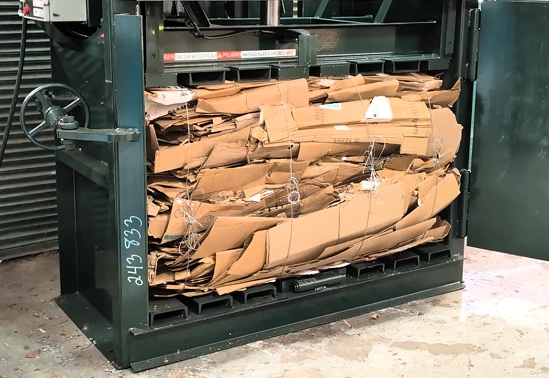
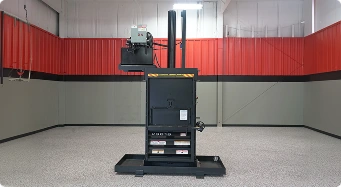
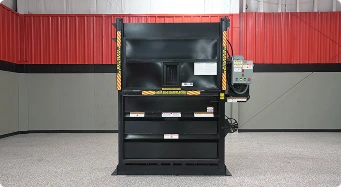
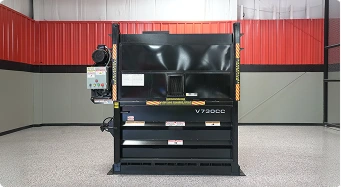
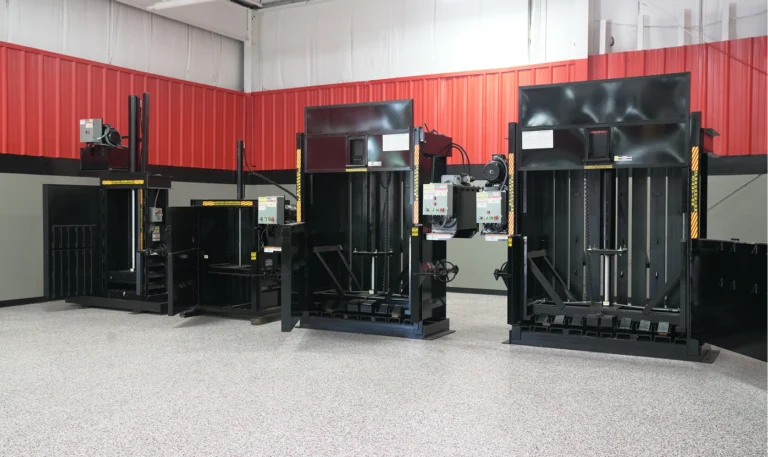
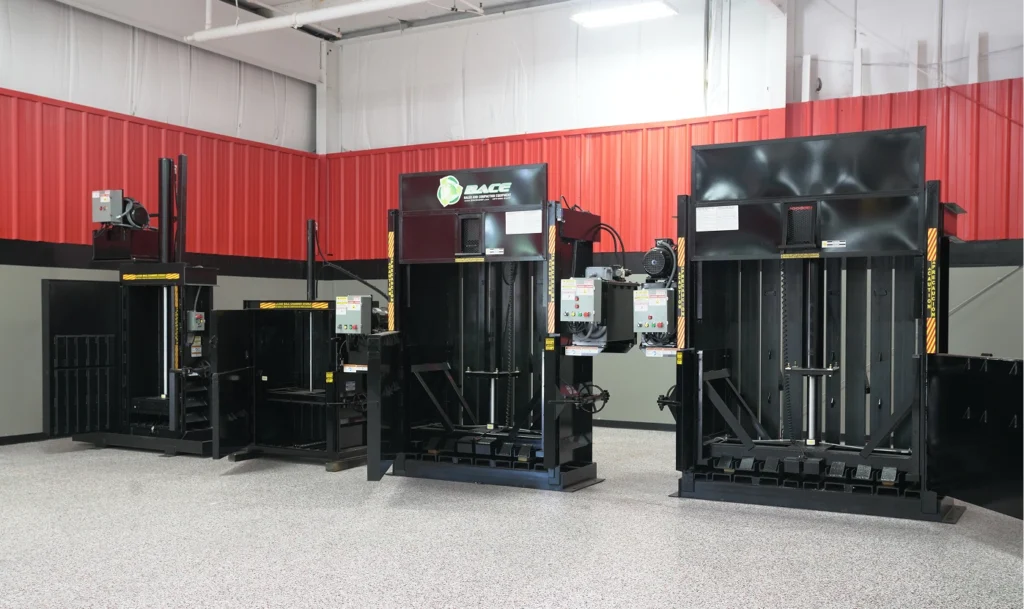
Vertical balers are an efficient, space-saving solution for compacting recyclables and other recoverable materials. Light- to mid-duty models are ideal for small businesses or limited-space operations, while heavy-duty units handle higher volumes and denser materials. By compressing cardboard, plastics, and other recyclables into manageable bales, these systems reduce hauling frequency, optimize storage, and support sustainable waste-diversion initiatives.
Compact and efficient, these models deliver strong compaction for cardboard and recyclables in tight spaces where full-size equipment won’t fit.
The industry standard for high-density bales that meet mill specifications. These balers balance capacity, performance, and footprint, making them the preferred choice for retail, distribution, and manufacturing environments.
Engineered for high-volume, industrial-scale operations. Heavy-duty frames and higher compaction force handle dense materials and maximize throughput for demanding applications.
Our balers deliver what matters most: reliable performance, minimal downtime, and equipment that adapts to your operation instead of limiting it.
Heavy-duty steel construction resists wear and tear for long service life.
Powerful compaction creates dense bales that reduce hauling costs and command higher value.
Built-in safety features—including interlocked doors, emergency stops, and hands-free zones—protect operators during every cycle while meeting rigorous safety standards.
Flexible configurations and options—such as front/rear feed, auto bale eject, and full bale indicators—make integration seamless without changing your production layout.
Space-conscious designs are ideal for facilities where floor space comes at a premium.
Comprehensive warranty coverage, readily available parts, and responsive service teams keep your baler running at peak performance for years to come.
“I never hesitate to recommend our vertical trash compactor because it does everything your brochure represents it to accomplish. I can’t imagine anyone in the restaurant business not utilizing this apparatus. It really has become one of my proudest restaurant possessions. It works so smoothly that I almost feel smug when I see all the gigantic trash containers for other restaurants.”
Robert Leonardi, Leonardi's Restaurant, Fort Lauderdale, Florida
“Our facility is a 110,000-square-foot operations center for Goodwill of Southwestern Pennsylvania. We get between 1.2 to 1.5 million pounds of material a day, and tonnage increases significantly during the summer. The Komar auger has increased daily soft trash, wood pallets, and general trash efficiency by 30% and 40% with furniture. I love to give shock-and-awe tours to show off the Komar Auger, which compacts 8.5 to 9 tons into each payload.”
Bob Kagle, Director of Retail Logistics, Goodwill of Southwestern Pennsylvania
“Since installing our Komar Auger, we have improved our operations tremendously. The auger units have reduced labor from six people down to one person, who oversees the conveyor lines and compactors. We have gone from a 2-ton payload to a 10-ton-plus payload, per 40-yard container, reducing our annual pull charges by over 75%. We have less downtime and have eliminated jams due to the slow operation of the old compactors. Best of all, we had less than a one-year return on investment.”
John Hefty, Operations Manager, GameStop
“We estimate that the Komar Auger has saved us 1,300 hours of labor per year, has reduced our hauling cost by two-thirds, and has given La-Z-Boy a safer process and more floor space.”
Troy Kvingedal, Facilities Supervisor, La-Z-Boy
“Our disposal costs have dropped, which at least covers the cost of the compactors. Aside from the monetary aspect, the compactors allow the stores to be considerably cleaner. Cleanup at night is much easier because we have no trash cluttering up the back room of the store. All in all, we are very pleased with the compactors.”
Doug Gehrig, CEO, McDonald’s of Southwest Louisiana
Before you invest in a vertical baler, it’s important to understand the difference between models under 60”, standard-sized 60” designs, and high-capacity systems over 60”. This guide lays out all the information you need to know when deciding which size will deliver the greatest benefit in your recycling operations.
Our solutions are tailored to meet the unique needs of a wide range of industries:
Vertical balers use a hydraulic ram to compress loose recyclables—such as cardboard, paper, and plastics—into dense, stackable bales. This process reduces storage space, lowers hauling costs, and prepares material for recycling.
Choose a baler based on your material volume and available floor & ceiling space. Compact models (under 60”) fit tight spaces and handle light loads. Mill-size balers (60”) produce dense bales that meet recycling mill specs, ideal for retail and distribution. Heavy-duty models over 60” are designed for high-volume or industrial applications.
Yes. Vertical balers handle OCC/cardboard, mixed paper, plastic wrap and film, shrink-wrap, aluminum cans, PET bottles, rigid plastics, and non-woven textiles. This versatility makes them ideal for facilities with diverse recycling needs.
Standard balers are built for light to moderate volumes. Heavy-duty models include reinforced steel frames, larger hydraulic cylinders, and higher compaction force to process dense materials and maximize throughput.
Most of our vertical balers include a semi-automatic bale eject system for easy removal. On some models, full-auto eject may be an optional upgrade.
Operators should complete basic training and review safety materials before use. Komar balers include clear controls and safety interlocks, but proper training is essential for safe, compliant operation.
Cycle time for a single compression stroke is typically 30–70 seconds, depending on the model and material. Completing a full bale depends on how quickly material is loaded and can vary widely.
Routine maintenance includes checking hydraulic fluid levels, inspecting hoses and seals, clearing debris from the chamber, lubricating moving parts, and testing safety interlocks. We offer scheduled preventive maintenance programs to maximize uptime and extend equipment life.
Yes. We provide flexible financing plans, leasing programs, and rental options to help you manage capital costs while upgrading your waste handling systems.
Absolutely. We offer OEM parts, preventive maintenance programs, and nationwide field service support to keep your baler running at peak performance.
Most mid- and heavy-duty vertical balers require three-phase electrical service (typically 208V, 230V, 460/480V, or 575V for Canadian installations), with custom setups available when needed. If you’re unsure about your facility’s power or don’t have three-phase, our team will guide you through the requirements and help coordinate with your electrical contractor before installation.
We are a waste solutions company. With a wide array of application-specific models and advanced engineering capabilities, we look forward to guiding you to the best solution for the job.
Schedule a free waste stream evaluation to identify the right equipment and processes for your space, waste types, and volume.
Choosing the right vertical baler size is one of the most important decisions in optimizing your recycling process. As Komar Industries integrates the legacy of BACE, PTR, and Compactors Inc., our goal is to provide clear guidance rooted in decades of industrial waste-handling experience.
Understanding Vertical Baler Size Categories
Vertical balers are generally grouped into three size classes: under 60-inch balers, 60-inch balers, and over 60-inch balers. Each serves a different operational need.
Balers Under 60″
Best for:
These balers offer the foundational benefits of compaction and bale organization without imposing heavy space or power requirements.
60-Inch Balers
Best for:
The 60″ vertical baler is widely considered the industry standard—efficient, reliable, and adaptable across multiple sectors.
Balers Over 60″
Best for:
These large-format balers create fewer, denser bales, reducing handling labor and transportation frequency.
The Wise Approach to Baler Selection
A vertical baler should match your workflow—not force your workflow to adapt. Assess material type, volume, operator traffic, and the long-term goals of your recycling program before selecting a size.