
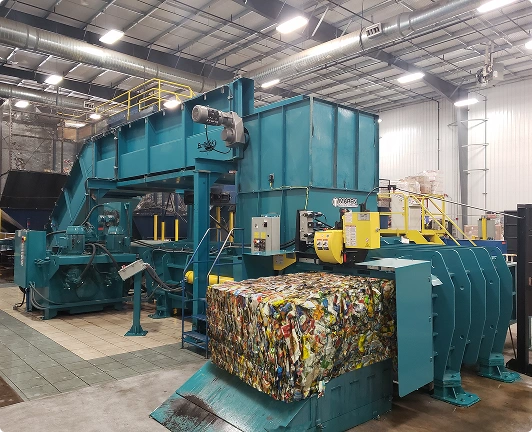




Two‑Ram Horizontal Balers deliver high‑output performance through optimized compaction, fast material changeovers using separation doors, flexible motor configurations, progressive shear technology that helps reduce jams, and durable interlocking steel construction. They are built for large‑volume recyclers, manufacturers, and municipal waste facilities.
*Select dry, non‑organic MSW only. Komar Two‑Ram Balers are not designed for wet waste, food waste, or heavily contaminated municipal refuse.
175,000 lbs
Cylinder Bore
6”
Dry Cycle
Bale Weight (OCC)
185,000 lbs
Cylinder Bore
5.5"
Dry Cycle
Bale Weight (OCC)
211,000 lbs
Cylinder Bore
8”
Dry Cycle
Bale Weight (OCC)
267,000 lbs
Cylinder Bore
9”
Dry Cycle
Bale Weight (OCC)
286,000 lbs
Cylinder Bore
9”
Dry Cycle
Bale Weight (OCC)
353,000 lbs
Cylinder Bore
10”
Dry Cycle
Bale Weight (OCC)
428,000 lbs
Cylinder Bore
11”
Dry Cycle
Bale Weight (OCC)
509,000 lbs
Cylinder Bore
12”
Dry Cycle
Bale Weight (OCC)
Dry cycle times depend on motor configuration (HP).
“Our previous baler was a manual tie, and if we’d knock out 20 bales in a day, you were doing pretty good,” he says. “Now, we can do 20 bales pretty easily in just two or three hours, so there’s been a huge difference.”
Scott Cisco, Auglaize County Solid Waste District
Some waste streams demand more than speed—they require power, adaptability, and resilience. Two-ram balers answer that call. Engineered for heavy-duty applications, they handle a wide range of materials while producing dense, consistent bales.
| Two-Ram Horizontal Balers | ![]() HT175 | ![]() HT185 | ![]() HT210 | ![]() HT265 | ![]() HT285 | ![]() HT350 | ![]() HT425 | ![]() HT500 |
|---|---|---|---|---|---|---|---|---|
| Feed Opening (LxW) | 78″ × 54″ | 48″ × 54″ | 64″ × 57″ | 64″ × 57″ | 64″ × 57″ | 80″ × 57″ | 100″ × 57″ | 100″ × 57″ |
| Bale Size (LxHxW) | 60″x30″x38-51* | 60″x30″x38-51* | 60″x30″x38-51* | 60″x30″x38-51* | 60″x30″x38-51* | 60″x30″x38-51* | 60″x30″x38-51* | 60″x30″x38-51* |
| System Pressure | 4,200 psi | 4,200 psi | 4,200 psi | 4,200 psi | 4,500 psi | 4,500 psi | 4,500 psi | 4,500 psi |
| Ram Force | 175,000 lbs | 185,000 lbs | 211,000 lbs | 267,000 lbs | 286,000 lbs | 353,000 lbs | 428,000 lbs | 509,000 lbs |
| Ram Pressure | 102 psi | 109 psi | 123 psi | 156 psi | 167 psi | 206 psi | 250 psi | 297 psi |
| Drive HP | 20 | 20 | 2×20 | 2×30 | 2×40 | 2×50, 3×40 | 3×50, 3×75 | 3×50, 3×75 |
| Main Cylinder Bore | 6″ | 5.5″ | 8″ | 9″ | 9″ | 10″ | 11″ | 12″ |
| Dry Cycle Time | 40 sec | 28 sec | 17 sec | 22 sec | 11 sec | 11–15 sec | 14.5 sec | 17 sec |
| Bale Tying | 5 wire, auto | 5 wire, auto | 5 wire, auto | 5 wire, auto | 5 wire, auto | 5 wire, auto | 5 wire, auto | 5 wire, auto |
| Baler Shipping Weight | 32,500 lbs | 28,500 lbs | 70,950 lbs | 73,850 lbs | 76,350 lbs | 93,750–97,750 lbs | 109,350 lbs | 112,350 lbs |
*Bale length dependent on selected baler configuration.
Our solutions are tailored to meet the unique needs of a wide range of industries, including:
Two-ram balers can process a variety of materials including OCC, shredded and mixed paper, tissue scraps, plastics, plastic film, and more.
Two-ram balers use separate chambers for compaction and for tying and side ejection, allowing continuous operation and faster processing. This design also enables cleaner, immediate changeover between materials. Single-ram balers perform compaction, tying, and ejection in a single channel, with completed bales pushed out by the next bale. Manual-tie and auto-tie single-ram designs offer different advantages depending on material and throughput needs.
Bales are tied in the extrusion chamber using an automatic 5-wire system that ensures consistent high-density.
Processing speed is driven by how quickly hydraulic fluid can be moved through the system. In a horizontal baler, the motor powers the hydraulic pump, which controls fluid flow to the cylinder. Increasing motor horsepower (within system limits) increases flow rate, reducing cycle time and allowing faster bale production.
Bale weight depends on material density, bale dimensions, and compaction level. Two-ram balers offer variable bale lengths, with compaction varying by model and application. As an example, OCC bales measuring approximately 30″×60”×48” typically weigh 1,500–1,700 lbs, depending on the type and condition of the OCC.
The bale separation door moves in place after the previous bale moves from the compression into the extrusion chamber. This creates separation between the previous and new bales, eliminating cross-contamination.
Bale density is driven by the amount of force applied during compaction. In a horizontal baler, hydraulic pressure is generated by the pump, while compaction force is determined by the size of the hydraulic cylinder. Increasing cylinder size increases the force applied by the ram, resulting in denser, heavier bales.
As with all hydraulic equipment, routine inspection of hoses, connections, and fluid levels is essential. Komar horizontal balers feature accessible external grease points for quick, straightforward lubrication. Wear components such as floor and side plates and multi-edge shear blades should be regularly inspected and rotated or replaced as needed. Komar also offers Preventive Maintenance programs to support long-term, reliable operation.
We are a waste solutions company. With a wide array of application-specific models and advanced engineering capabilities, we look forward to guiding you to the best solution for the job.
Schedule a free waste stream evaluation to identify the right equipment and processes for your space, waste types, and volume.
Some waste streams demand more than speed—they require power, adaptability, and resilience. Two-ram balers answer that call. Engineered for heavy-duty applications, they handle a wide range of materials while producing dense, consistent bales.
With separate rams for compression and ejection, these machines excel in environments where material type changes frequently or where maximum bale density is required.
Best For:
Key Advantages of Two-Ram Balers
The Komar Advantage
Choose a two-ram baler when versatility, bale density, and material flexibility guide your recycling strategy. For complex waste streams, no solution offers more capability or long-term clarity.