When your operation generates large volumes of dry, bulky recyclables, a horizontal baler is often the ideal solution. Designed for high-throughput environments, horizontal balers maximize bale density and reduce the frequency of hauls, helping facilities cut disposal costs and optimize space. From automated tie systems to heavy-duty two-ram designs, these machines handle high-throughput material streams while optimizing performance, making them a smart choice for warehouses, distribution centers, manufacturing sites, and large retail operations.
*Select dry, non‑organic MSW only. Komar Two‑Ram Balers are not designed for wet waste, food waste, or heavily contaminated municipal refuse.
Komar horizontal balers are built to deliver under the most demanding real-world conditions.
Variable piston pumps generate higher system pressures for optimized compaction with less strain on the equipment, enabling tighter bales, longer service life, and the potential for smaller cylinder options.
Automated operation keeps the baler running with minimal supervision. That means fewer bottlenecks and greater output, even during high-volume events.
Made with heavy-duty steel components for maximum endurance and durability under extreme conditions.
A baler’s power and efficiency comes down to three components: pump technology, cylinder size/design, and motor power. Their combined impact might not be obvious on a spec sheet, but they’re the reason some balers outperform others in real-world conditions.
“We went from paying $18,000 to $20,000 a year for plastic removal by a local waste company to selling our compacted bales to our pots and tray manufacturers for $8,000 to $10,000 per year! So… we paid for our baler in less than a year! Every time the baler runs, it sounds just like printing money. Thanks for delivering a great product and one that does exactly what you said it would! Very refreshing to deal with an honorable company.”
John Hardiman, American Farms, Green V60XD
Our solutions are tailored to meet the unique needs of a wide range of industries, including:
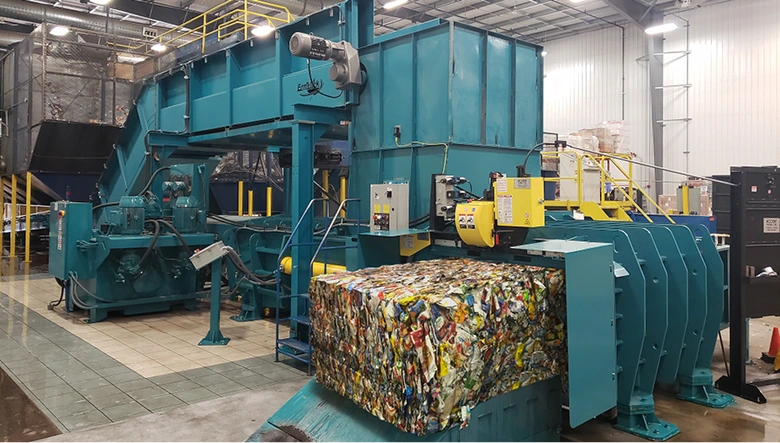
A horizontal baler is an industrial compaction machine that continuously compresses loose recyclables into dense, tied bales using horizontal hydraulic ram pressure. Material is fed into the chamber and compacted in a linear motion to efficiently process high volumes while reducing space, handling, and transport needs.
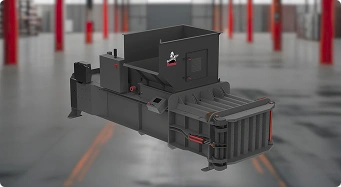
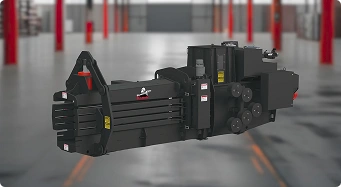
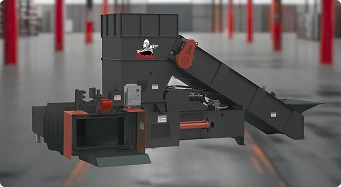
Closed-door and auto-tie models are single-stage machines. Closed-door balers are designed for lower-volume operations, requiring manual bale tying while allowing easy switching between feed materials. Auto-tie balers are suited for high volumes of consistent material streams and reduce manual involvement through automatic tying. Two-ram balers use a dual-chamber, dual-ram design—one for compaction and one for automatic tying and ejection—combining material flexibility with automated, high-volume performance.
Horizontal balers can process most dry, compressible materials from both recycling and waste streams. Common examples include cardboard, paper, plastics, aluminum, tin, and steel cans, textiles, carpet, foam, insulation, and municipal solid waste (MSW).
Variable piston pumps provide higher pressure than traditional hi/lo vane pumps, delivering greater compaction force for the same cylinder size. This improves efficiency, extends system life, and allows cylinder downsizing while maintaining comparable compaction performance.
Safety is built into every Komar horizontal baler. Features include guards on moving parts, interlocks that prevent operation when doors or panels are open, emergency stops, and automated systems designed to minimize risk.
Komar cleanliness balers are designed for low-maintenance operation. Standard tasks include checking hydraulic fluid cleanness and levels, lubricating moving parts, inspecting pumps and cylinders, and testing safety interlocks. We also recommend semi-annual or annual service by a Komar technician to keep your equipment running smoothly.
Closed-door balers include wire guides in the compaction chamber for manual tie-off. Auto-tie and two-ram balers utilize an automatic tying system.
Yes. Komar horizontal balers can be tailored with custom hoppers, feed systems, and other automations to fit seamlessly into your operations.
Yes. Our balers can integrate with conveyors or automated feeders to accept material continuously throughout operation.
We provide full support for all the machines we carry, including OEM replacement parts, preventative maintenance programs, and nationwide expert field service.
We are a waste solutions company. With a wide array of application-specific models and advanced engineering capabilities, we look forward to guiding you to the best solution for the job.
Schedule a free waste stream evaluation to identify the right equipment and processes for your space, waste types, and volume.
In today’s waste-conscious world, efficient recycling and waste processing isn’t just smart — it’s essential. Horizontal balers have become workhorses for businesses of all sizes, turning bulky recyclables like cardboard, plastics, and fiber into dense, transport-ready bales that save space, increase rebate values, and reduce hauling costs.
What Is a Horizontal Baler?
A horizontal baler is a large industrial machine that compresses recyclable material into tightly packed bales. Unlike vertical balers, horizontal machines are designed for high volume throughput and continuous operation.
They are common in distribution centers, grocery stores, manufacturing facilities, retail operations, recycling centers, and more. They can be found anywhere recycling volumes are significant.
Key Performance Drivers in Horizontal Balers
When evaluating horizontal balers, whether auto-tie, closed-door manual tie, or two-ram systems, there are several core features and design elements that directly impact performance.
Bale Density and Compression Power
A baler’s ability to produce high-density bales is one of the most important performance indicators.
High performance tip: Look for balers with robust hydraulics and optimized platen force to consistently achieve dense bales across a variety of materials.
Tie Systems: Auto-Tie vs. Manual Tie
How a baler ties has major implications for throughput and labor costs:
Auto-Tie Balers
Closed-Door Manual Tie Balers
Choosing between auto-tie and manual tie depends on your balance between labor efficiency and upfront investment.
Single-Ram vs. Two-Ram Systems
Horizontal balers come primarily in two configurations:
Single-Ram
Two-Ram
Performance insight: Two-ram systems typically improve overall throughput and minimize operator intervention — a big advantage in high-demand environments.
Throughput Capacity
Throughput — how much material the machine can process in a given period — is influenced by:
For some operations, fast throughput with moderate bale density may be the priority. For others, maximum bale density at slightly slower throughput may save more in transportation costs or increase rebate values. Komar’s horizontal baler solutions help you dial in the right balance for your business.
Ease of Use and Maintenance
Operators shouldn’t need an engineering degree to run a baler efficiently. Features that drive usability include:
Reliable performance isn’t just about power, it’s also about simplicity and uptime.
Why Komar’s Horizontal Balers Deliver
With our integration of Maren Engineering’s proven designs, Komar Industries offers horizontal balers that exemplify performance, durability, and flexibility:
Whether you’re processing cardboard, plastics, fiber, or mixed recyclables, understanding these performance drivers will help you choose the right baler for your operation.
Choose Smarter, Bale Better
Selecting the right horizontal baler isn’t just about picking a model, it’s about aligning machine performance with your operational goals. At Komar Industries, we pair industry expertise with robust baler technology that keeps your recycling program running strong.
Ready to optimize your waste processing? Contact Komar today for a baler consultation and see how our horizontal balers can elevate your recycling efficiency.