


Vertical Compactors

Waste Disposal in Space-Constrained Environments

In space-constrained environments like ships, restaurants, compact commercial facilities, and urban buildings, Komar Vertical Compactors cut disposal frequency, and maintain sanitation—critical where storage is limited and removal is infrequent.

Indoor VS Outdoor Vertical Compactors

Indoor Vertical Compactor

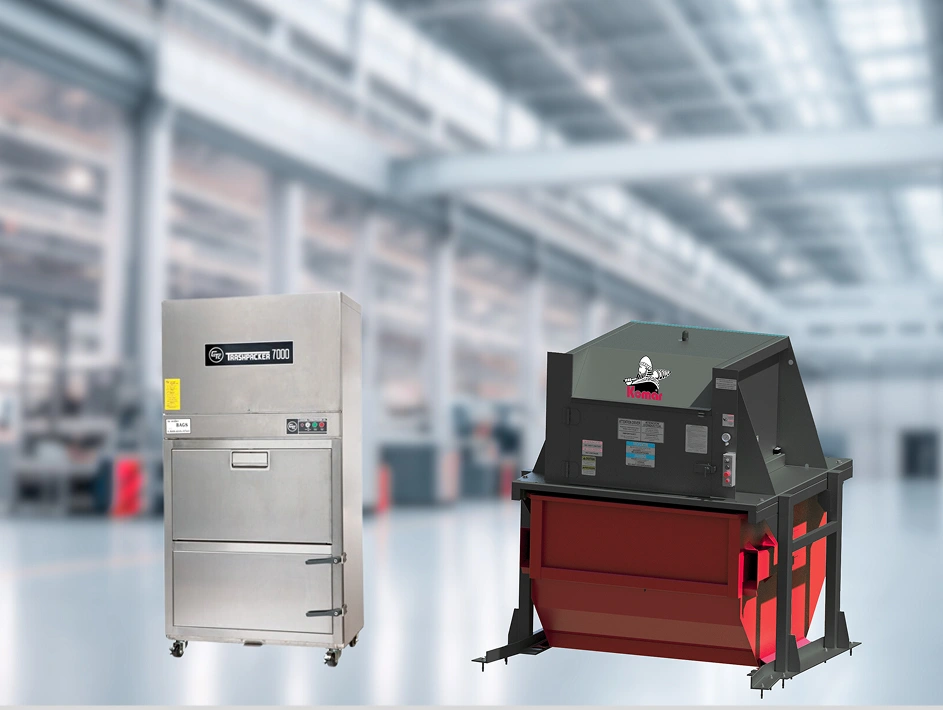
Komar Chicago Trashpacker

Choose an indoor vertical compactor when:

  • Space is limited and waste must be managed inside (kitchens, retail stockrooms, hospitality areas)
  • Protection from weather is critical – rain, snow, and outdoor exposure is not an option.
  • Security concerns prevent outdoor waste storage.
  • Sanitary conditions matter for staff and guests, requiring odor control and easy cleaning.
  • Low-to-moderate waste volumes need efficient compaction without disrupting operations.

Key Features:

  • Stainless steel construction for durability and hygiene.
  • Reusable trash cube system with optional bag usage on select models for flexibility.
  • Optional UV germicidal unit for odor reduction and control of bacteria, virus, and harmful contaminants.
  • Compact footprint with heavy-duty casters for mobility.

Outdoor Vertical Compactor

Komar VC4-8

Choose an outdoor vertical compactor when:

  • High-capacity equipment is needed to handle large waste volumes.
  • Space is available outdoors for waste storage and hauler access.
  • Centralized waste collection streamlines operations.
  • Continuous operation is required without interfering with indoor activities.
  • Maintaining a clean, odor-free interior is essential for staff and guest comfort.

Key Features:

  • Heavy-duty steel construction for rugged outdoor environments.
  • Large container capacity for fewer hauls and lower disposal costs.
  • Designed for easy hauler access and efficient waste management.

PRODUCT LINE OVERVIEW

Ideal for space-constrained indoor environments where security and sanitation are priorities

TA3000

TA3000

is ideal for light-duty use in tight spaces

Capacity
3.3 cu. ft.
Cycle Time
11-15 sec.
Machine Height (in.)
71.25"
Machine Width (in.)
22.25"
Machine Depth (in.)
22.25"

TA4500

suits medium-volume applications with moderate space constraints

Capacity
6 cu. ft.
Cycle Time
18-22 sec.
Machine Height (in.)
77.75"
Machine Width (in.)
28.25"
Machine Depth (in.)
28"

TA7000

handles heavy loads in high-demand space-constrained settings

Capacity
9 cu. ft.
Cycle Time
20-25 sec.
Machine Height (in.)
80.25"
Machine Width (in.)
40.25"
Machine Depth (in.)
28"

Best for high-volume waste operations with outdoor space to keep refuse and odors outside

VC4

perfect for limited clearance and space-sensitive areas

Overall Height (in.)
92"
Frame Height (in.)
43"
Container Height (in.)
41"
Processing Capacity (cu. yd)
120
Charge Box Capacity
.73 cu. yd.

VC6

offers a low-profile for
confined areas

Overall Height (in.)
101"
Frame Height (in.)
57"
Container Height (in.)
54.5”
Processing Capacity (cu. yd)
120
Charge Box Capacity
.73 cu. yd

VC8

designed for elevated loading for dock or platform integration

Overall Height (in.)
123"
Frame Height (in.)
75"
Container Height (in.)
72.5"
Processing Capacity (cu. yd)
120
Charge Box Capacity
.73 cu. yd.

Vertical Compactor Specifications

Indoor Vertical Compactors TA3000SS TA3000SS TA4500SS TA4500SS TA7000SS TA7000SS
Height (in.) 71.25 77.75 80.25
Width (in.) 22.25 28.25 40.25
Depth (in.) 22.25 28 28
Service Weight (lbs.) 700 900 1200
Loading Chute Door Opening (in.) 15.25 × 18 19 × 24 20.5×36
Compaction Chamber Size (in.) 37.5 × 18.75 × 18.25 40.5 × 24 × 24 71.75 × 36 × 24
Capacity (cu. ft.) 3.3 6 9
Compaction Ratio Up to 20:1 Up to 20:1 Up to 20:1
Cycle Time (sec.) 11 to 15 18 to 22 20 to 25
Motor Size (hp) 0.5 0.5 1
Electrical Requirements 120 or 240 volts 9/4.5 amps 120 or 240 volts 9/4.5 amps 120 or 240 volts 14/7 amps
Maximum Compaction Force (lbs.) 8,640 13,500 24,000
Working Space (in.) 46 × 22 54 × 30 66 × 42
Outdoor Vertical
Compactors

VCP-4

VCP-4


VCP-6

VCP-6


VCP-8

VCP-8

Compactor Height92″101″123.25″
Height to Top of light97″106″128″
Compactor Head Width101″101″101″
Compactor Depth85.5″85.5″85.5″
Overall Compactor Width96.5″96.5″96.5″
Load Height45.25″58.25″76.5″
Charge Box Capacity.73 cu-yd [.6 cu-m].73 cu-yd [.6 cu-m].73 cu-yd [.6 cu-m]
Feed Opening26″x48″ [66 cm x 122 cm]26″x48″ [66 cm x 122 cm]26″x48″ [66 cm x 122 cm]
Processing Capacity Per Hour120 cy/hr120 cy/hr120 cy/hr
Average Cycle Time30s30s30s
Total Normal Force26,389 lbs [117,384 N]26,389 lbs [117,384 N]26,389 lbs [117,384 N]
Total Maximum Force30,159 lbs [134,154 N]30,159 lbs [134,154 N]30,159 lbs [134,154 N]
Normal Ram Pressure15 psi [103 Kpa]15 psi [103 Kpa]15 psi [103 Kpa]
Maximum Ram Pressure17 psi [117 Kpa]17 psi [117 Kpa]17 psi [117 Kpa]
Electric208/230/460 – 3 phase208/230/460 – 3 phase208/230/460 – 3 phase
Control Voltage120 VAC120 VAC120 VAC
Motor3 HP3 HP3 HP
Pump3.2 gpm [12.1 L/m]3.2 gpm [12.1 L/m]3.2 gpm [12.1 L/m]
Normal Pressure2,100 psi [13,790 Kpa]2,100 psi [13,790 Kpa]2,100 psi [13,790 Kpa]
Maximum Pressure2,400 psi [15,858 Kpa]2,400 psi [15,858 Kpa]2,400 psi [15,858 Kpa]
Cylinder Bore4″ [10.2 cm]4″ [10.2 cm]4″ [10.2 cm]
Cylinder Rod2″ [5 cm]2″ [5 cm]2″ [5 cm]
Weight5,000 lbs [2,268 Kg]5,000 lbs [2,268 Kg]5,000 lbs [2,268 Kg]

Common Vertical Compactor Options

Front-Feed Vertical Compactor

Designed for loading waste from the front, this compactor is ideal for space-restricted areas, offering easy access and efficient compaction.

Rear-Feed Vertical Compactor

Rear-feed vertical compactors support disciplined waste management by separating loading and service areas, offering a practical solution for dock or alley installations that require safe and organized material flow.

Side-Feed Vertical Compactor

Side-feed vertical compactors offer adaptable access through a lateral loading door, enabling thoughtful placement in confined spaces while maintaining effective and reliable compaction performance.

Resource

Indoor vs Outdoor Vertical Compactors: Which One Is Right for Your Business?

Indoor vs Outdoor Vertical Compactors: Which One Is Right for Your Business?

INDUSTRIES WE SERVE

Our solutions are tailored to meet the unique needs of a wide range of industries, including:

FAQs

Both systems have the same purpose—compressing dry waste to reduce volume—but serve different needs. Vertical compactors load from the top and operate vertically in a smaller footprint that works well in tight spaces, such as retail stockrooms and restaurants. 


Standard compactors operate horizontally, compressing materials into large roll-off containers with more capacity. They require more space, which is why they’re typically used in industrial or high-output facilities.

Vertical compactors are intended for cardboard, plastics, paper, textiles, food packaging, and other dry, non-hazardous wastes. Wet materials and medical waste should not be placed in vertical compactors.

Consider your usable floor space and vertical clearance, power needs, and application when making a selection. Some models are designed to fit in smaller areas with low ceilings, while others can be integrated with loading decks. Compact models, such as the Komar Chicago Trashpacker, are small enough for shipboard installation or tight indoor spaces.

Outdoor models, such as the VC4, VC6 and VC8, can process up to 120 cubic yards per hour, making them ideal for high-volume operations. Trashpacker models are made for lower volumes and and frequent indoor use.

VC models need 9–10.5 feet of ceiling clearance and more floor space for access and operation. Trashpackers, by comparison, can operate with ceilings as low as 6.5 feet and require much less space.

Simple controls, built-in safety features, emergency stops, and secure access make operation straightforward. Training is recommended for all operators to ensure safe, effective use.

VC models compress materials into internal containers that are removed and emptied by waste haulers when full. 


Trashpacker models use a reusable trash cube system that’s ejected whe full. Bags or liners that provide added containment and sanitation are available for select models.

Compactors and trashpackers should be cleaned daily, inspected monthly, and professionally serviced at least once per year to ensure reliable operation—especially for hydraulic systems.

Yes. Trashpacker models are well-suited for tight quarters and offshore platform. VC models, like the VC4 and VC6, can be installed on larger ships with sufficient space and clearance.

Absolutely. We offer options like chute integration, odor control systems, stainless steel enclosures, and marine-specific modifications depending on your needs.

Indoor vs Outdoor Vertical Compactors: Which One Is Right for Your Business?

Indoor vs. Outdoor Vertical Compactors: Which One Is Right for Your Facility?

When it comes to managing waste efficiently, choosing the right type of trash compactor is essential. Whether you’re operating in a retail store, restaurant, manufacturing facility, or marine environment, the decision between an Indoor vertical compactor and an outdoor vertical compactor can impact everything from workflow and cleanliness to cost savings and compliance.

Let’s break down the key differences and considerations—using the Komar Chicago Trashpackers (indoor) and the Komar VC units (outdoor) as leading examples in their respective categories.


Why Choose an Indoor Vertical Compactor Like the Chicago Trashpacker?

Indoor vertical compactors are designed to operate inside your facility, making them ideal for businesses with limited space or strict cleanliness standards. The Chicago Trashpacker stands out as a compact, stainless-steel unit that fits seamlessly into tight indoor environments, including commercial kitchens, cruise ships, offshore rigs, and retail backrooms.


Here are a few reasons to choose an indoor vertical compactor:

  • Compact Footprint: Designed for space-constrained areas where large outdoor equipment won’t fit.
  • Weather-Protected: Keeps waste dry and contained without exposure to the exterior.
  • Operational Efficiency: Allows staff to dispose of trash near the point of generation, minimizing trips to outdoor dumpsters.
  • Improved Hygiene: Reduces the risk of pests and odors by managing waste in a controlled indoor environment.
  • Security and Compliance: Ideal for secure facilities where outdoor waste storage may not be permitted.


Why Choose an Outdoor Vertical Compactor Like the Komar VC6?

Outdoor vertical compactors are heavy-duty systems built for high-volume waste management. The Komar VC6 is a robust unit commonly found behind convenience stores, pharmacies, and restaurants where limited space is available.


Key advantages of an outdoor vertical compactor include:

  • Larger Capacity: Better suited for facilities that generate a high volume of waste on a regular basis.
  • Centralized Collection: Supports a single outdoor location for all waste, simplifying disposal logistics.
  • Minimized Indoor Interference: Keeps noise, odor, and waste-handling activity outside the building.
  • Built for the Elements: Engineered to withstand weather, temperature fluctuations, and outdoor wear and tear.
  • Hauler-Friendly Design: Allows for easy pickup and emptying by commercial waste haulers.


Final Thoughts: Which Compactor is Best for You?

The choice between an indoor and outdoor vertical compactor comes down to your environment, space limitations, and operational needs.

If you’re dealing with tight quarters, strict sanitation requirements, or marine/offshore applications, the Chicago Trashpacker offers unmatched convenience and durability in an indoor setting. On the other hand, if your facility can accommodate outdoor waste management and you generate larger volumes of trash, a Komar VC unit may be the more efficient choice.


One-Sentence Summary:
Choose the Chicago Trashpacker for compact, clean, and convenient indoor waste management, and Komar VCs for rugged, high-capacity outdoor compaction built to handle larger volumes with ease.